No products in the cart.

10 Tips for Passing Your Food Handler’s Certificate Exam
Exams are stressful, and the pressure of passing may leave you feeling overwhelmed and nervous that you won’t pass, even


Long hours and unpredictable shifts can quickly blur the line between work and personal life for restaurant teams in Canada. With unique pressures in hospitality, work-life balance is more than splitting time between job and home—it means thoughtful scheduling, attention to mental health, and respecting personal boundaries. This guide explores realistic strategies to help Canadian restaurant leaders build a culture where staff feel valued and operations stay efficient.
| Point | Details |
|---|---|
| Work-Life Balance Integration | Achieving work-life balance involves more than just time allocation; it requires integrating personal and professional needs within the hospitality sector. |
| Effective Scheduling Practices | Implementing flexible scheduling and digital tools can enhance employee satisfaction and operational efficiency. |
| Staff Wellbeing as a Priority | Promoting staff wellbeing through mental health resources and supportive leadership is essential for long-term success. |
| Legal Compliance Responsibilities | Employers must ensure adherence to Canadian labour standards while fostering a culture of support and respect for employees. |
Work-life balance in the hospitality sector represents a complex, dynamic challenge specific to restaurants and food service environments. Contemporary research highlights this concept as more than simply dividing time between professional responsibilities and personal life – it’s about creating meaningful integration and sustainable performance.
In the Canadian hospitality context, work-life balance involves managing several interconnected dimensions:
The hospitality industry presents unique challenges compared to other sectors. Research systematically demonstrates that erratic shift patterns, extended working hours, and high-pressure environments significantly impact employee well-being. Restaurant managers must proactively design workplace cultures that support staff mental health and sustainable career trajectories.
Understanding work-life balance requires recognizing its multifaceted nature. It’s not just about reducing hours, but creating meaningful workplace experiences that honour employees’ holistic needs. This approach involves thoughtful scheduling, clear communication, professional development opportunities, and genuine respect for personal boundaries.
Pro tip: Implement rotating shift schedules that provide predictability and allow employees to plan personal commitments in advance.
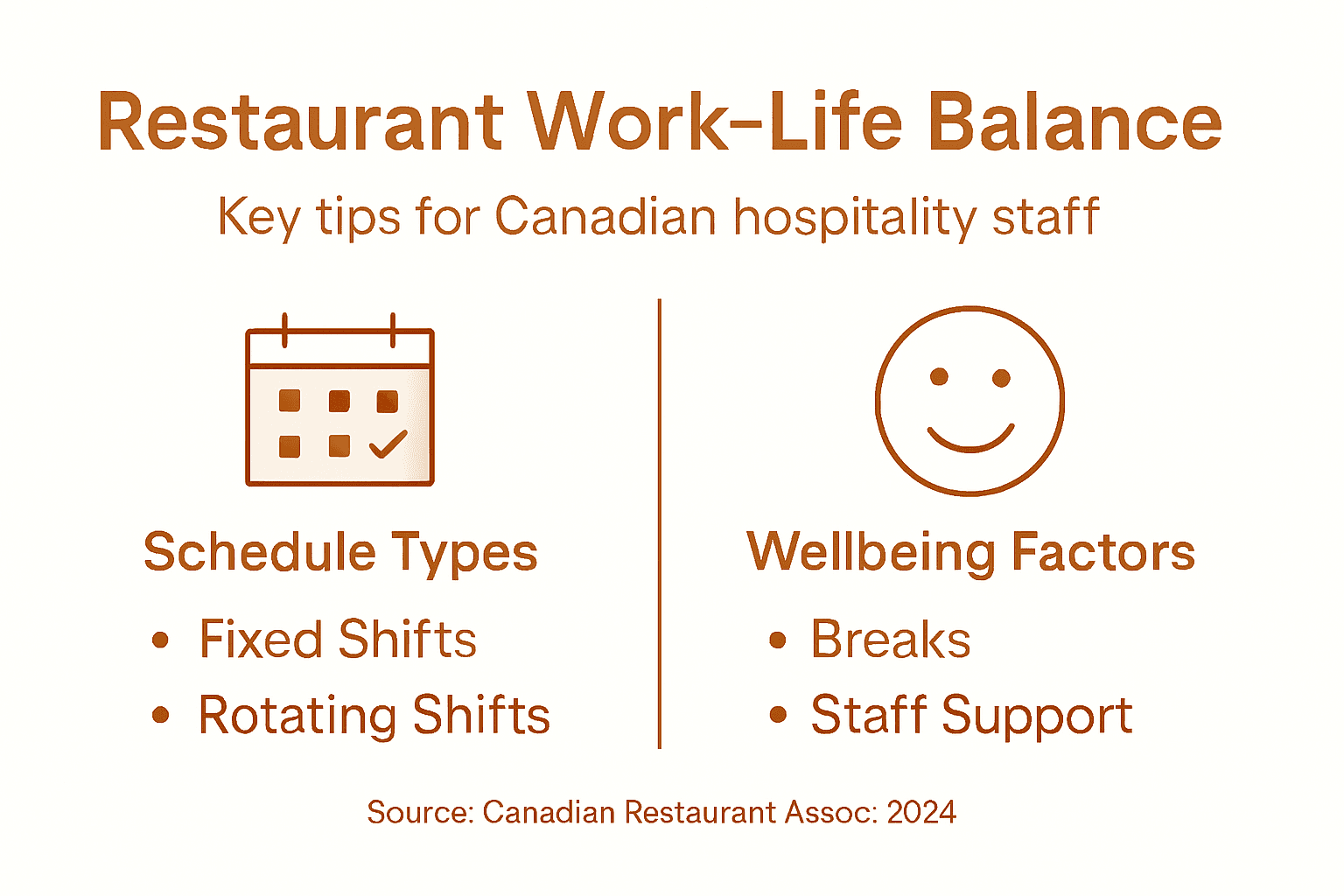
Restaurant work schedules are complex systems designed to balance operational needs with employee well-being. Restaurant scheduling approaches encompass multiple strategies that impact workforce management, productivity, and staff satisfaction.
The primary types of work schedules in restaurant environments include:
Restaurant management research indicates that each schedule type presents unique advantages and challenges. Fixed shifts provide predictability, allowing employees to plan personal commitments, while rotating shifts offer workforce flexibility and prevent monotony.

Effective scheduling requires careful consideration of employee preferences, peak business hours, and regulatory compliance. Restaurant managers must balance operational demands with staff well-being, creating schedules that support both business efficiency and individual work-life integration.
Here’s a comparison of common restaurant schedule types and their impact:
| Schedule Type | Employee Predictability | Operational Flexibility | Typical Challenges |
|---|---|---|---|
| Fixed Shifts | High | Low | Harder to adjust for peak times |
| Rotating Shifts | Moderate | High | Can disrupt personal routines |
| Split Shifts | Low | High | Fatigue, longer days |
| On-Call Scheduling | Very Low | Very High | Lacks stability, raises stress |
| Part-Time Flexible | Moderate | Moderate | May lack stable income |
Successful scheduling is about creating harmony between business needs and employee satisfaction.
Pro tip: Implement digital scheduling software that allows employees to input availability and swap shifts transparently.
Hospitality employee wellbeing represents a complex interplay of individual, organizational, and environmental factors unique to restaurant work environments. Understanding these interconnected elements is crucial for creating supportive workplace cultures that promote staff mental health and operational success.
Key factors influencing staff wellbeing include:
Recent Canadian workplace research highlights the critical importance of comprehensive wellness strategies. Restaurant managers must proactively address stressors by implementing holistic approaches that consider both individual employee needs and broader organizational dynamics.
The pandemic has fundamentally transformed workplace wellness expectations, demanding more nuanced and empathetic management approaches. Restaurant leaders must recognize that staff wellbeing is not just a human resources metric, but a critical component of operational sustainability and team performance.
Staff wellness is a strategic investment, not an optional expense.
Pro tip: Conduct quarterly anonymous wellness surveys to understand and address emerging staff mental health challenges.
The following table summarises key actions to improve employee wellbeing in Canadian restaurants:
| Action Area | Example Initiative | Potential Benefit |
|---|---|---|
| Scheduling Flexibility | Self-service shift swapping | Reduces last-minute absenteeism |
| Mental Health Support | Free counselling access | Lowers stress and staff turnover |
| Professional Growth | Ongoing skills workshops | Boosts morale and retention |
| Leadership Training | Manager empathy workshops | Creates supportive workplace culture |
| Social Support | Monthly staff events | Increases team cohesion |
Canadian labour standards create a comprehensive framework designed to protect employee rights and promote workplace fairness in the hospitality sector. These regulations establish critical guidelines for scheduling, compensation, and work-life balance that directly impact restaurant management practices.
Key legal obligations for Canadian employers include:
Recent legislative amendments have expanded employee rights, particularly in federally regulated workplaces. Restaurant managers must now navigate more nuanced requirements for accommodating flexible work arrangements while balancing operational needs.
The legal landscape demands proactive approach to employee rights. Employers must develop comprehensive policies that not only meet minimum legal standards but also create supportive workplace cultures that prioritize staff well-being and professional development.
Legal compliance is the foundation of a respectful and sustainable workplace.
Pro tip: Consult with employment law specialists annually to ensure your restaurant’s policies remain current with evolving labour regulations.
Organizational strategies play a crucial role in creating supportive environments that address the unique challenges of work-life balance in restaurant settings. Understanding and implementing comprehensive approaches can significantly improve employee well-being and organisational performance.
Key best practices for supporting work-life balance include:
The Fair and Decent Work Agenda emphasizes creating holistic workplace environments that go beyond traditional management approaches. Restaurant leaders must develop strategies that address both operational efficiency and employee personal needs, recognizing that staff well-being directly impacts organisational success.
Successful implementation requires a cultural shift towards viewing employees as whole individuals with complex personal and professional lives. This means creating systems that support individual needs while maintaining operational excellence, ultimately building resilience and reducing workplace stress.
Work-life balance is not a luxury, but a fundamental requirement for sustainable workplace performance.
Pro tip: Conduct quarterly wellness surveys and create actionable improvement plans based on employee feedback.
Canadian restaurant managers face the critical challenge of balancing staff well-being with operational demands in high-pressure environments. The article highlights scheduling flexibility, mental health support, and stress reduction as essential components to foster a sustainable work-life balance. One way to create a supportive workplace culture is by equipping your team with up-to-date knowledge on food safety and workplace standards. At Probe It Food Safety.ca, we offer flexible, government-accredited online courses such as Food Handler Certification and WHMIS that empower employees with essential skills without disrupting their personal commitments.

Take proactive steps now to reduce stress and improve employee confidence with training designed by public health experts. Visit Probe It Food Safety.ca to explore courses that fit your restaurant’s unique scheduling needs. Invest in your staff’s professional development and mental well-being today to build a stronger, healthier workplace for tomorrow.
Work-life balance in hospitality involves creating meaningful integration of professional and personal life, focusing on scheduling flexibility, emotional resilience, and personal time management to support employee well-being.
Different work schedules, such as fixed, rotating, and split shifts, impact employee predictability and operational flexibility, which can influence staff satisfaction and stress levels in the hospitality environment.
Key factors include workload management, emotional labor, social support systems, leadership engagement, and creating flexible work-life integration options for employees.
Employers are required to comply with flexible work requests, minimum wage standards, overtime compensation, leave entitlements, and workplace safety regulations, which are crucial for ensuring employee rights and welfare.
Exams are stressful, and the pressure of passing may leave you feeling overwhelmed and nervous that you won’t pass, even

Food safety is essential if you want to ensure safety and establish trust with your customers. Food handlers must be

Practicing good food safety habits is paramount to maintaining a healthy kitchen. Regardless of the size of your hotel business