No products in the cart.

10 Tips for Passing Your Food Handler’s Certificate Exam
Exams are stressful, and the pressure of passing may leave you feeling overwhelmed and nervous that you won’t pass, even


Restaurant uniforms might seem all about looks and branding. Think again. Uniforms do far more than create a matching team vibe. Uniform policies are a frontline defence for food safety and employee hygiene, drastically cutting contamination risk and boosting professionalism. Here is the unexpected part. The correct uniform guideline does not just protect the food and the staff. It shapes how customers trust your restaurant from the second they walk through the door.
| Takeaway | Explanation |
| Uniforms uphold food safety standards | Uniforms create barriers that prevent contamination between personal clothing and food. |
| Consistent appearance enhances brand image. | Uniforms reflect a restaurant’s professionalism and attention to detail, reinforcing its brand identity. |
| Specific materials improve staff comfort and functionality | Choosing the right fabrics ensures that uniforms are durable, comfortable, and appropriate for various work roles. |
| Clear guidelines foster a unified team culture. | A detailed uniform policy helps establish shared expectations, promoting team unity and professional standards. |
| Professional uniforms build customer trust. | Well-maintained uniforms signal to customers that the establishment values cleanliness, quality, and safe dining experiences. |
A restaurant staff uniforms policy is a comprehensive set of guidelines that define the professional dress code, appearance standards, and clothing requirements for employees working in a food service establishment. This policy serves as a critical framework for maintaining workplace professionalism, hygiene standards, and brand representation.
The primary purpose of a restaurant staff uniforms policy extends far beyond simple aesthetic considerations. It represents a strategic approach to ensuring consistent professional appearance, food safety, and operational efficiency. Staff food safety responsibilities play a crucial role in defining these uniform expectations.
Uniform policies typically address several key aspects:
Specific clothing items required for different job roles
Cleanliness and maintenance expectations
Personal grooming standards
Colour and style requirements that align with restaurant branding
Practical considerations for food handling and safety
A well-designed restaurant staff uniforms policy encompasses multiple dimensions. Material selection becomes critical, with fabrics chosen for durability, comfort, and ease of cleaning. Colour coordination helps create a cohesive visual identity, while functional design ensures employees can perform their duties comfortably and safely.
The policy must balance practical requirements with professional appearance. For kitchen staff, this might mean breathable, stain-resistant materials that can withstand high-temperature environments. Front-of-house employees might require more customer-facing attire that reflects the restaurant’s ambiance and brand personality.
Beyond aesthetics, uniforms serve critical hygienic functions. They create a barrier between personal clothing and food preparation areas, reducing contamination risks and supporting overall food safety protocols. By standardizing employee appearance, restaurants can also enhance their professional image and create a sense of team unity and shared purpose.
Below is a table outlining the key components found in a comprehensive restaurant staff uniforms policy, along with their purposes and relevance.
| Component | Description | Purpose/Benefit |
| Material Selection | Choice of fabrics for uniforms, such as breathable or stain-resistant materials | Ensures durability, comfort, and hygiene |
| Color Coordination | Using specific colours to align with restaurant branding | Creates a cohesive brand image |
| Functional Design | Features that boost safety and comfort, like non-slip footwear or headwear | Supports safe, efficient workplace operations |
| Cleanliness Expectations | Guidelines for uniform care and maintenance | Promotes hygiene and professionalism |
| Personal Grooming Standards | Expectations for hair, jewelry, and personal grooming | Reduces contamination risks, supports image |
| Role-Specific Items | Requirements for particular items (chef jackets, aprons, name tags) for different staff roles | Clarifies responsibilities, supports hierarchy |
| Maintenance Protocols | Rules for laundering and upkeep of uniforms | Preserves professional appearance and safety |
A restaurant’s uniform policy is far more than a simple dress code. It serves as a multifaceted operational strategy that directly impacts food safety, professional image, employee performance, and customer perception. How to Show Customers Your Commitment to Hygiene and Food Safety underscores the critical role uniforms play in establishing trust and credibility.
Uniforms are a fundamental component of food safety protocols. Professional attire creates critical barriers that protect both food and customers from potential contamination. Specific design features prevent loose clothing and exposed personal items, and minimize the risk of foreign-object introduction into food-preparation areas.
Key safety considerations include:
Preventing hair from falling into food
Minimizing skin contact with prepared dishes
Creating a physical barrier between personal clothing and food preparation zones
Supporting overall workplace hygiene standards
Uniforms function as a visual representation of a restaurant’s brand identity and professionalism. They communicate organizational values, attention to detail, and commitment to quality before a single word is spoken. A consistent appearance signals to customers that the establishment maintains high standards across all aspects of its operation.
A well-designed uniform policy transforms employees into brand ambassadors. It creates a sense of unity, belonging, and collective purpose. When staff members look professional and cohesive, customers perceive the restaurant as organized, trustworthy, and dedicated to delivering exceptional dining experiences.
Moreover, uniforms help establish clear visual hierarchies within restaurant environments. Different styles or colour variations can quickly communicate an employee’s role and staff position to both customers and colleagues, enhancing operational efficiency and communication.
A comprehensive restaurant staff uniforms policy requires strategic planning and detailed consideration of multiple essential elements. Your Essential Guide to Proper Kitchen Attire for Safety and Hygiene highlights the intricate nature of developing practical uniform guidelines that balance practicality, safety, and professional appearance.
Fabric selection plays a crucial role in uniform effectiveness. Different restaurant areas demand specialized materials that support specific workplace functions. Kitchen uniforms require heat-resistant, easy-to-clean fabrics that can withstand frequent washing and high-temperature environments. Front-of-house staff might need more aesthetically refined materials that maintain a crisp, professional appearance throughout service hours.
Key material considerations include:
Durability and resistance to stains
Breathability and comfort for extended wear
Easy maintenance and cleaning potential
Appropriate weight for different restaurant environments
Compliance with food safety regulations
A well-structured uniform policy details exact specifications for each staff role.
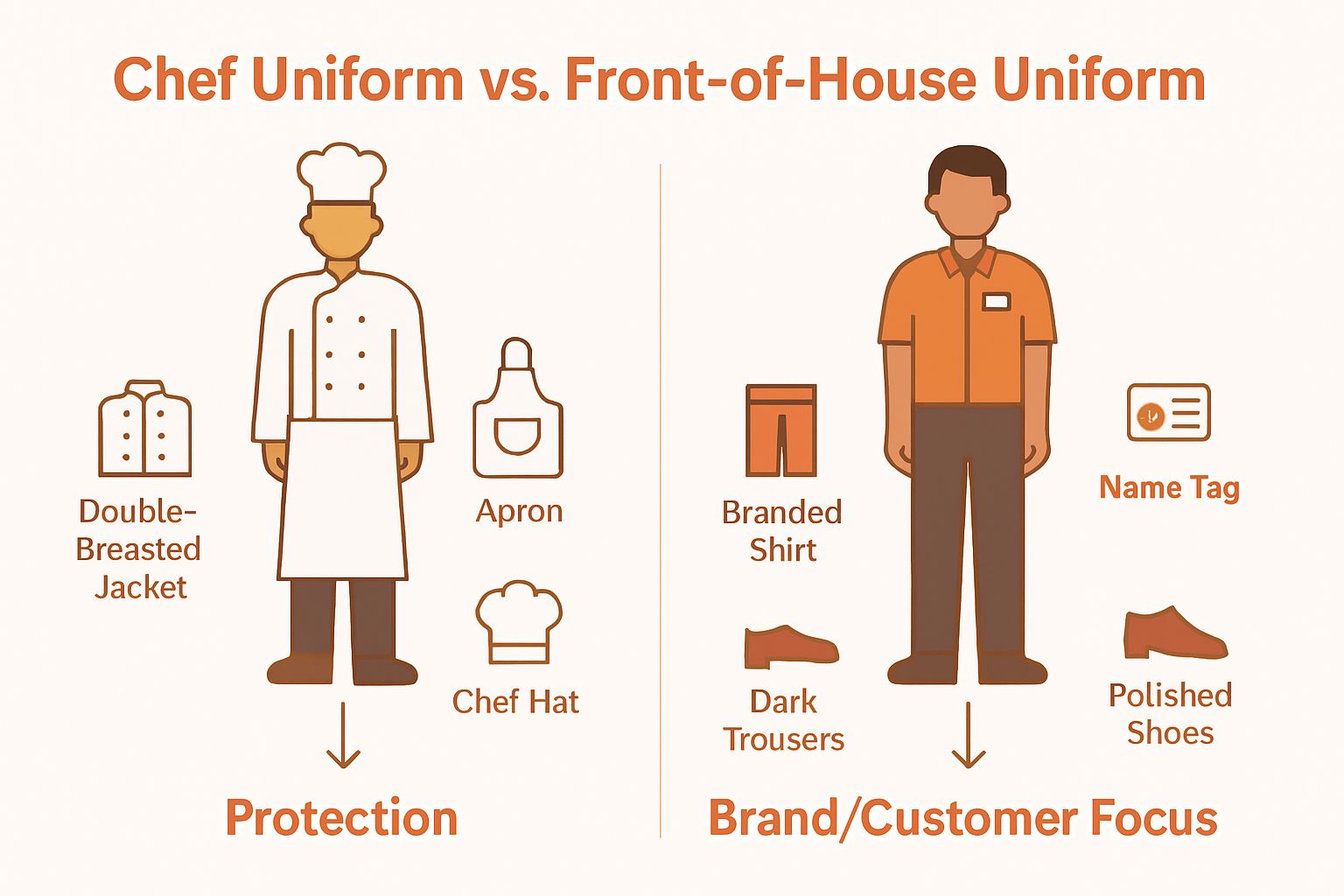 Comprehensive guidelines outline precise requirements for every clothing item, ensuring consistency and professionalism across the entire restaurant team.
Typical uniform components might include:
Chef jackets with specific colour designations
Aprons for different kitchen and service roles
Headwear to prevent hair contamination
Non-slip footwear for safety
Name tags or identification badges
The policy must also address personal grooming standards that complement the uniform requirements. This includes guidelines on hair restraints, jewelry restrictions, and overall personal presentation that support food safety and professional image. By establishing clear, detailed expectations, restaurants create a unified workplace culture that prioritizes hygiene, safety, and professional standards.
A strategic restaurant staff uniforms policy goes beyond operational requirements and directly influences customer perception and dining satisfaction. Online Food Handling Certificate programs emphasize how professional appearance contributes to overall customer trust and experience.
Uniforms serve as a silent communication tool that instantly conveys professionalism, organization, and competence. Before a customer interacts with staff, their uniforms create an immediate visual narrative about the restaurant’s standards and commitment to quality. A cohesive, well-maintained uniform signals attention to detail and suggests a similar level of meticulousness in food preparation and service.
Several uniform-related factors shape customer perception:
Cleanliness and maintenance of attire
Consistency across staff members
Professional fit and appearance
Colour coordination with restaurant branding
Individual staff members’ confidence
Customers subconsciously associate staff appearance with food safety and overall dining quality. Uniforms create a psychological barrier of trust, suggesting that the restaurant takes its operational standards seriously. When employees look professional and unified, customers feel more confident about the hygiene and quality of their dining experience.
A well-designed uniform policy communicates several key messages:
Commitment to food safety standards
Organizational discipline
Respect for customer expectations
Investment in staff professional development
Cultural values of the restaurant
Beyond aesthetic appeal, uniforms help customers quickly identify staff roles, streamline their interaction, and create a more efficient and comfortable dining environment. By establishing a clear, professional visual language, restaurants transform their uniforms from mere clothing into powerful tools of customer experience management.

Successful restaurant uniform policies demonstrate how strategic clothing guidelines can transform workplace culture and customer experience. Staff Food Safety Responsibilities for Canadian Restaurants & Schools 2025 underscores the importance of practical, implementable, uniform standards across different dining environments.
Fine dining establishments typically adopt the most rigorous uniform policies, where attire becomes an extension of their brand identity. These restaurants often implement highly detailed guidelines that consider:
Precise colour matching to restaurant branding
Custom-tailored uniforms for each staff position
Strict grooming and accessories standards
Seasonal uniform variations
Professional laundry and maintenance protocols
For example, high-end restaurants in the Michelin-star category often require servers to wear tailored black or white shirts, pressed black trousers, polished shoes, and minimal jewelry. Chef uniforms are equally precise, featuring traditional white double-breasted jackets, checkered pants, and specific headwear that indicate culinary hierarchy.
Casual dining environments develop uniform policies that balance practicality with brand personality. These policies focus on comfort, functionality, and team unity. Such restaurants typically create uniforms that are:
Comfortable for extended shifts
Easy to clean and maintain
Reflective of the restaurant’s casual aesthetic
Allowing for individual personality expression
Adherent to basic food safety standards
Chain restaurants like casual burger joints or pizza establishments often use branded t-shirts, aprons, and baseball caps that create a consistent look while allowing staff some personal comfort. The uniform becomes a walking advertisement for the restaurant, promoting brand recognition and creating a sense of team identity.
This table compares the typical approaches to staff uniforms policies between fine dining and casual/fast-casual restaurants, highlighting their unique characteristics and objectives.
| Restaurant Type | Uniform Characteristics | Focus/Purpose | Example Elements |
| Fine Dining | Tailored, colour-coordinated, strict grooming and accessory standards | Reinforce exclusivity, brand and professionalism | Black/white shirts, checkered pants |
| Casual/Fast-Casual | Comfortable, easy to clean, branded, but allows personality | Balance comfort, function, and brand personality | Branded t-shirts, aprons, caps |
These real-world examples demonstrate that an effective uniform policy is never one-size-fits-all. Instead, it must be carefully tailored to reflect the restaurant’s specific culture, brand identity, and operational requirements while maintaining essential food safety and professional standards.
You understand that a clear restaurant staff uniforms policy protects your reputation, supports food safety, and builds customer trust. But gaps in staff training or inconsistent understanding of hygiene can break even the strongest uniform guidelines. Mistakes in food handling, confusion around brand standards, and compliance worries all become real concerns without reliable knowledge at every level.
Get ahead by empowering your team with government-accredited training from Probe It Food Safety.ca. Our flexible online Food Handler Certification and workplace safety courses reinforce everything your uniform policy stands for—secure instant certification 24/7, designed by public health experts for the Canadian restaurant industry. Commit to higher standards today—visit Probe It Food Safety.ca and safeguard both your business and your brand.
A restaurant’s staff uniform policy establishes guidelines for employee appearance, promoting professionalism, hygiene, and brand representation. To implement this, create clear expectations for attire, grooming, and overall appearance within your restaurant.
Developing an effective uniform policy involves defining clothing items, style, and specific roles for your staff. Start by outlining the dress code requirements that align with your brand’s identity and operational needs within the next 30 days.
A comprehensive restaurant uniforms policy should include material requirements, maintenance expectations, and personal grooming standards. Specify these components in your policy document to ensure all employees understand the expectations and comply accordingly.
Uniforms enhance food safety by creating barriers that minimize contamination risks in food preparation areas. Ensure your policy includes guidelines on clothing design, such as preventing loose items and using appropriate materials, to maintain safety standards during operations.
Without a uniform policy, there may be inconsistencies in employee appearance, which can negatively affect customer perceptions and food safety. To avoid this, establish a clear, uniform policy within the next 60 days to ensure professionalism and operational efficiency in your restaurant.
A well-executed uniform policy can enhance the customer experience by creating a cohesive, professional appearance among staff. Focus on training your team to consistently adhere to uniform standards to maintain a positive impression and build customer trust.
Exams are stressful, and the pressure of passing may leave you feeling overwhelmed and nervous that you won’t pass, even

Food safety is essential if you want to ensure safety and establish trust with your customers. Food handlers must be

Practicing good food safety habits is paramount to maintaining a healthy kitchen. Regardless of the size of your hotel business