No products in the cart.

10 Tips for Passing Your Food Handler’s Certificate Exam
Exams are stressful, and the pressure of passing may leave you feeling overwhelmed and nervous that you won’t pass, even


Every menu presents a challenge when customers and families bring unique dietary requirements to the table. For Canadian food service managers, special diet accommodations are much more than a courtesy—they are an obligation rooted in national health guidance and evolving regulatory standards. This overview explains how well-defined accommodations and diligent staff training help create inclusive, safe meal experiences for everyone, especially as new allergen and dietary protocols become top priorities in Canada.
| Point | Details |
|---|---|
| Importance of Special Diet Accommodations | Food service managers must implement modifications to meet diverse dietary needs for inclusivity and safety. |
| Regulatory Compliance | Adhering to Canadian food safety regulations is essential to mitigate risks and maintain high standards. |
| Staff Training | Comprehensive training on dietary restrictions and communication is critical for ensuring safe food service practices. |
| Ingredient Management | Developing detailed ingredient documentation and tracking systems is vital for allergen management and transparency. |
Food service managers face complex challenges when providing safe and inclusive meal options for individuals with diverse dietary requirements. Special diet accommodations represent strategic modifications to food preparation, menu design, and service protocols to meet nutritional, medical, health, and personal dietary needs of customers and clients.
Canada’s food service regulations provide clear guidance on accommodating special dietary requirements. The Official Food Dietary Exemption Order outlines comprehensive definitions and standards for specialized food modifications. These accommodations typically address several key dietary considerations:
Understanding these accommodations requires recognizing the nuanced approaches food service professionals must take. Canada’s Food Guide emphasizes the importance of providing flexible, safe, and nutritionally balanced options that respect individual dietary needs while maintaining high food safety standards.
Implementing special diet accommodations involves multiple strategic considerations. Food handlers must develop comprehensive protocols that prevent cross-contamination, accurately communicate ingredient information, and create transparent preparation processes. This requires staff training, meticulous ingredient tracking, and robust communication systems between kitchen staff and customers.
Key Implementation Strategies:
Special diet accommodations are not just about restriction—they’re about creating inclusive, respectful dining experiences that prioritize individual health and personal choice.
Pro tip: Always maintain comprehensive ingredient documentation and train staff extensively on special diet protocols to ensure safe, reliable food service accommodations.
Canadian food service professionals encounter a diverse range of dietary restrictions that require careful understanding and strategic accommodation. Canada’s Dietary Guidelines highlight the complexity of these dietary needs, which extend far beyond simple food preferences and represent critical health and lifestyle considerations.
Among the most prevalent dietary restrictions observed nationwide are food allergies, which can range from mild sensitivities to potentially life-threatening reactions. Key allergenic categories include:
Beyond medical restrictions, cultural and ethical dietary choices play a significant role in Canadian food service landscapes. Alberta Health Services dietary guidelines recognize several prominent dietary preferences and restrictions:
Navigating these diverse dietary landscapes requires comprehensive staff training, precise ingredient documentation, and robust communication protocols. Food service managers must develop systematic approaches that respect individual dietary needs while maintaining high safety and quality standards.

The following table summarizes how different types of dietary restrictions impact food service operations in Canada:
| Dietary Restriction Type | Operational Challenge | Key Business Impact |
|---|---|---|
| Medical (e.g., allergies) | Requires segregation, precise tracking | Minimizes liability and ensures safety |
| Cultural/Religious | Demands menu flexibility and knowledge | Expands inclusivity and clientele |
| Ethical (vegetarian/vegan) | Necessitates alternative ingredient sourcing | Broadens menu appeal and compliance |
| Health-Specific (e.g., celiac) | Avoids cross-contact, diligent prep | Preserves guest trust and loyalty |
Understanding dietary restrictions is not just about compliance—it’s about creating inclusive, respectful dining experiences that honour individual health choices.
Key Accommodation Strategies:
Pro tip: Implement regular staff training on dietary restriction awareness and invest in detailed ingredient management systems to ensure safe, reliable food service accommodations.
Food service professionals must develop rigorous, systematic approaches to managing allergen and special diet requirements. Canadian Food Inspection Agency guidelines emphasize the critical importance of comprehensive protocols that protect vulnerable individuals and ensure food safety across all service environments.
Implementing effective allergen management protocols requires a multi-layered strategy that addresses several key operational dimensions:
Specific Protocol Requirements include comprehensive procedures for identifying, tracking, and managing potential allergen risks. Government food safety guidelines mandate systematic approaches that cover everything from ingredient sourcing to final meal preparation.
Kitchen staff must develop precise workflows that minimize cross-contamination risks. This involves creating dedicated preparation zones, using separate cooking equipment, and implementing stringent cleaning protocols between food preparation tasks. Colour-coded utensils, dedicated cutting boards, and systematic sanitization processes become critical components of an effective allergen management strategy.
Allergen management is not just a regulatory requirement—it’s a fundamental commitment to customer safety and well-being.
Critical Implementation Steps:
Pro tip: Develop a comprehensive allergen management handbook and conduct quarterly staff training to ensure consistent, up-to-date safety protocols.
Canadian food service businesses must navigate a complex landscape of regulatory requirements to ensure comprehensive food safety and consumer protection. Safe Food for Canadians Regulations provide the foundational legal framework that mandates rigorous standards for food handling, preparation, and service across all food-related industries.
The legal compliance framework encompasses multiple critical dimensions of food safety management:
Canada’s Food and Drugs Act establishes the overarching regulatory environment that governs food safety practices. This legislation empowers agencies like Health Canada and the Canadian Food Inspection Agency (CFIA) to enforce stringent standards that protect consumer health and ensure transparency in food production and service.
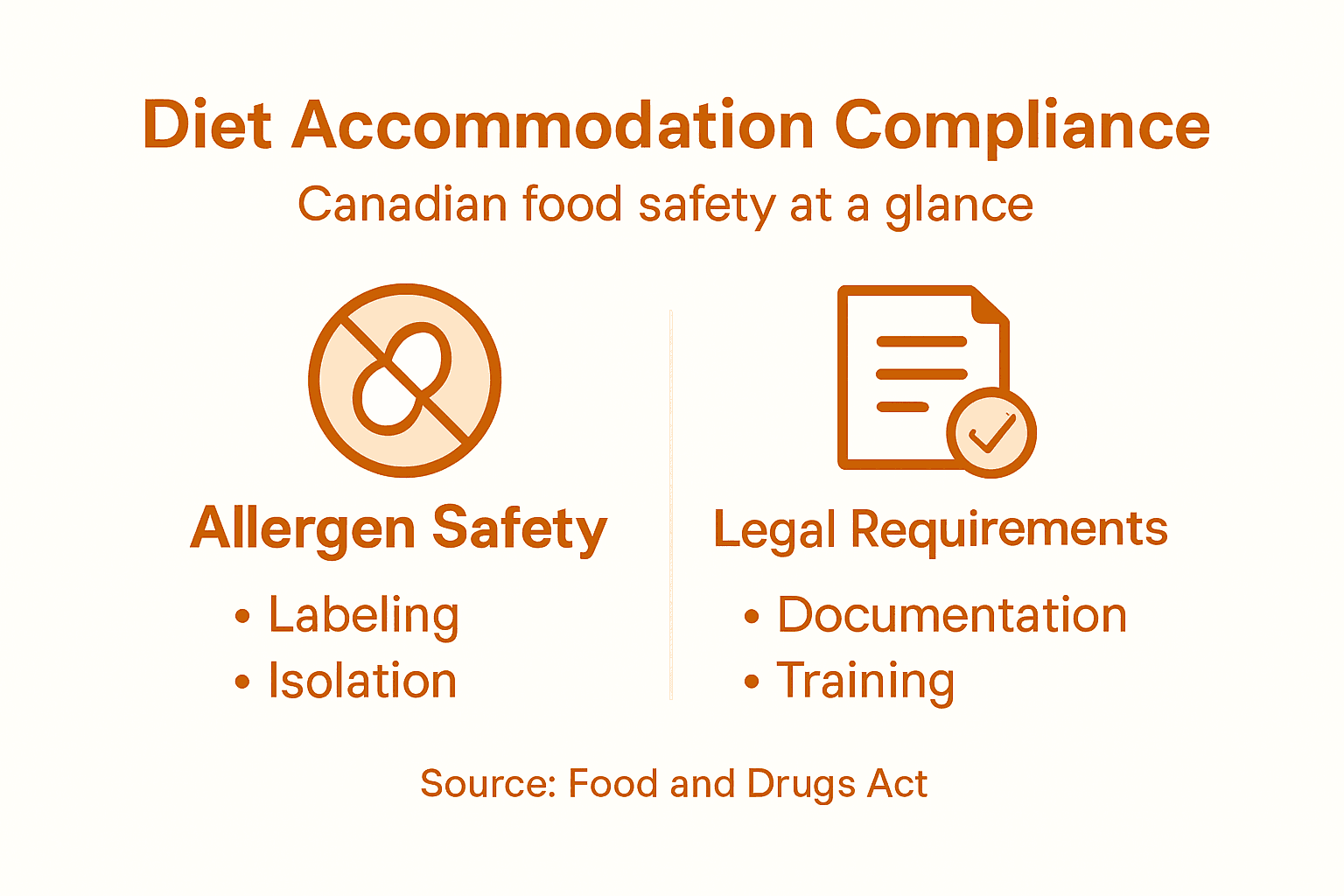
Food service managers must develop systematic approaches to legal compliance that go beyond mere documentation. This involves creating robust internal processes that proactively address regulatory requirements, including detailed record-keeping, staff training protocols, and comprehensive risk management strategies. Regular internal audits and continuous staff education become essential components of maintaining legal compliance.
Here’s a comparison of core protocols required for legal compliance in Canadian food service:
| Compliance Requirement | Why It Matters | Potential Consequences of Neglect |
|---|---|---|
| Ingredient Tracking | Ensures accurate allergen disclosure | Fines, recalls, reputational damage |
| Menu Labelling | Supports informed choices | Customer confusion, legal risk |
| Preventive Control Planning | Prevents foodborne illness outbreaks | Regulatory penalties, business closure |
| Staff Training | Reduces human error and enhances safety | Increased incident risk, compliance fines |
Legal compliance is not a static checklist—it’s a dynamic commitment to public health and safety.
Key Compliance Priorities:
Pro tip: Consult with a food safety legal expert annually to ensure your compliance protocols remain current with evolving regulatory standards.
Effective staff training for special diet accommodations requires a comprehensive, systematic approach that goes beyond basic compliance. Government accommodation guidelines emphasize the critical importance of developing robust communication strategies that promote understanding, respect, and proactive problem-solving.
Key Training Components for food service teams addressing special dietary requirements include:
Accommodation process guidelines highlight the necessity of creating an inclusive environment through structured communication strategies. Food service managers must develop training programs that equip staff with the knowledge, skills, and confidence to handle diverse dietary needs professionally and compassionately.
Implementing effective training involves more than traditional classroom instruction. Interactive workshops, scenario-based learning, and ongoing professional development are crucial. Staff must learn to navigate complex dietary requirements with empathy, precision, and a commitment to customer safety. This includes understanding legal obligations, recognizing potential cross-contamination risks, and developing clear communication protocols for discussing dietary restrictions with customers.
Effective staff training transforms dietary accommodation from a compliance requirement into a genuine commitment to customer care.
Communication Training Priorities:
Pro tip: Conduct quarterly role-playing exercises that simulate complex dietary accommodation scenarios to continuously improve staff responsiveness and confidence.
Ensuring food safety while managing special diet accommodations is a critical challenge for food service professionals across Canada. From preventing cross-contamination to mastering ingredient tracking and allergen protocols, the risks are real and the stakes are high. Your staff must be confident and well-trained to provide safe, inclusive dining experiences that meet legal and health standards.

Take control of your food safety compliance today by enrolling in flexible, government-accredited courses designed to address these exact challenges. At Probe It Food Safety.ca, you will find comprehensive training including Food Handler Certification and specialized food safety courses that equip your team with the knowledge and skills to navigate allergen management, cultural dietary needs, and regulatory compliance with ease. Act now to protect your customers and business with trusted online training available anytime. Visit Probe It Food Safety.ca to get started and ensure your food service operation meets Canada’s rigorous safety and accommodation standards.
Special diet accommodations refer to modifications made in food preparation, menu design, and service protocols to meet the diverse nutritional, medical, health, and personal dietary needs of customers. This includes considerations for allergies, cultural and religious requirements, ethical choices, and health-specific needs.
Food service managers can ensure food safety by developing comprehensive protocols to prevent cross-contamination, training staff on allergen awareness, implementing strict ingredient tracking systems, and maintaining clear communication with customers about dietary restrictions.
Food service professionals should be aware of common dietary restrictions such as food allergies (e.g., peanuts, dairy, gluten), religious dietary restrictions (e.g., Halal, Kosher), vegetarian and vegan preferences, and specific health-related needs like lactose intolerance or celiac disease.
Best practices for training staff include providing comprehensive allergen awareness education, developing communication skills, conducting sensitivity training, and utilizing practical exercises. Regular role-playing and scenario-based learning can enhance staff confidence in handling diverse dietary needs effectively.
Exams are stressful, and the pressure of passing may leave you feeling overwhelmed and nervous that you won’t pass, even

Food safety is essential if you want to ensure safety and establish trust with your customers. Food handlers must be

Practicing good food safety habits is paramount to maintaining a healthy kitchen. Regardless of the size of your hotel business