No products in the cart.

10 Tips for Passing Your Food Handler’s Certificate Exam
Exams are stressful, and the pressure of passing may leave you feeling overwhelmed and nervous that you won’t pass, even


Online training is completely changing how Canadian restaurants and schools approach professional development. Imagine cutting costs by as much as 226% average return on investment over three years just by switching to digital training platforms. Most expect flexibility to mean compromises on quality, but new technology is actually improving skill retention and making compliance simple. The real surprise is that the most effective training now happens outside the classroom and on your own schedule.
| Takeaway | Explanation |
|---|---|
| Online training offers unmatched flexibility | Professionals can learn at their pace, accommodating busy work schedules without disrupting operations. |
| Cost savings with digital training | Online platforms cut expenses for venues, materials, and instructor fees, creating a more efficient system. |
| Continuous learning enhances staff skills | Employees have access to ongoing training, ensuring they stay current with industry best practices and regulations. |
| Tailored content meets industry needs | Training can be customized to directly address specific operational challenges in hospitality and education sectors. |
| Technology enables immersive experiences | Use of interactive modules and adaptive learning technologies improves engagement and knowledge retention among staff. |
Workplace training has transformed dramatically, offering unprecedented flexibility for professionals in restaurants and educational settings. The traditional model of rigid, time consuming training programs no longer meets the dynamic needs of modern Canadian workplaces.
Online training benefits have revolutionized how professionals acquire new skills and certifications. According to the OECD report on Education in the Digital Age, digital training platforms significantly enhance workplace flexibility by allowing learners to complete courses without disrupting their primary job responsibilities. This approach is particularly critical for industries like food services and education, where time away from work can create substantial operational challenges.
Restaurant managers and school administrators face unique scheduling constraints. Online training provides a solution that allows employees to learn during off peak hours, during breaks, or from the comfort of their home. The self paced nature means individuals can progress through material at their own speed, accommodating varying learning styles and professional commitments.
Modern online training platforms leverage advanced technologies to create immersive, interactive learning experiences. Professionals can now access high quality educational content through mobile devices, tablets, and computers. Video tutorials, interactive modules, and real time assessments make learning engaging and effective.
The technological infrastructure supporting online training has become increasingly sophisticated. Adaptive learning algorithms can personalize content based on an individual’s existing knowledge, ensuring that training is both efficient and targeted. For restaurant staff learning food safety protocols or educators updating their pedagogical techniques, this means a more relevant and impactful learning experience.
Beyond flexibility, online training offers significant economic advantages for businesses. Traditional in person training involves substantial costs related to venue rental, instructor fees, and employee time away from work. Digital platforms dramatically reduce these expenses while maintaining high educational standards.
For Canadian restaurants and schools, this translates into a more sustainable approach to professional development. Employees can continuously upgrade their skills without creating major financial burdens for their organizations. Learn more about our interactive training approaches that make skill acquisition both accessible and engaging.
The future of workplace learning is flexible, technology driven, and learner centric. As industries continue to evolve, online training will play an increasingly critical role in helping professionals stay competitive and adaptable in their respective fields.
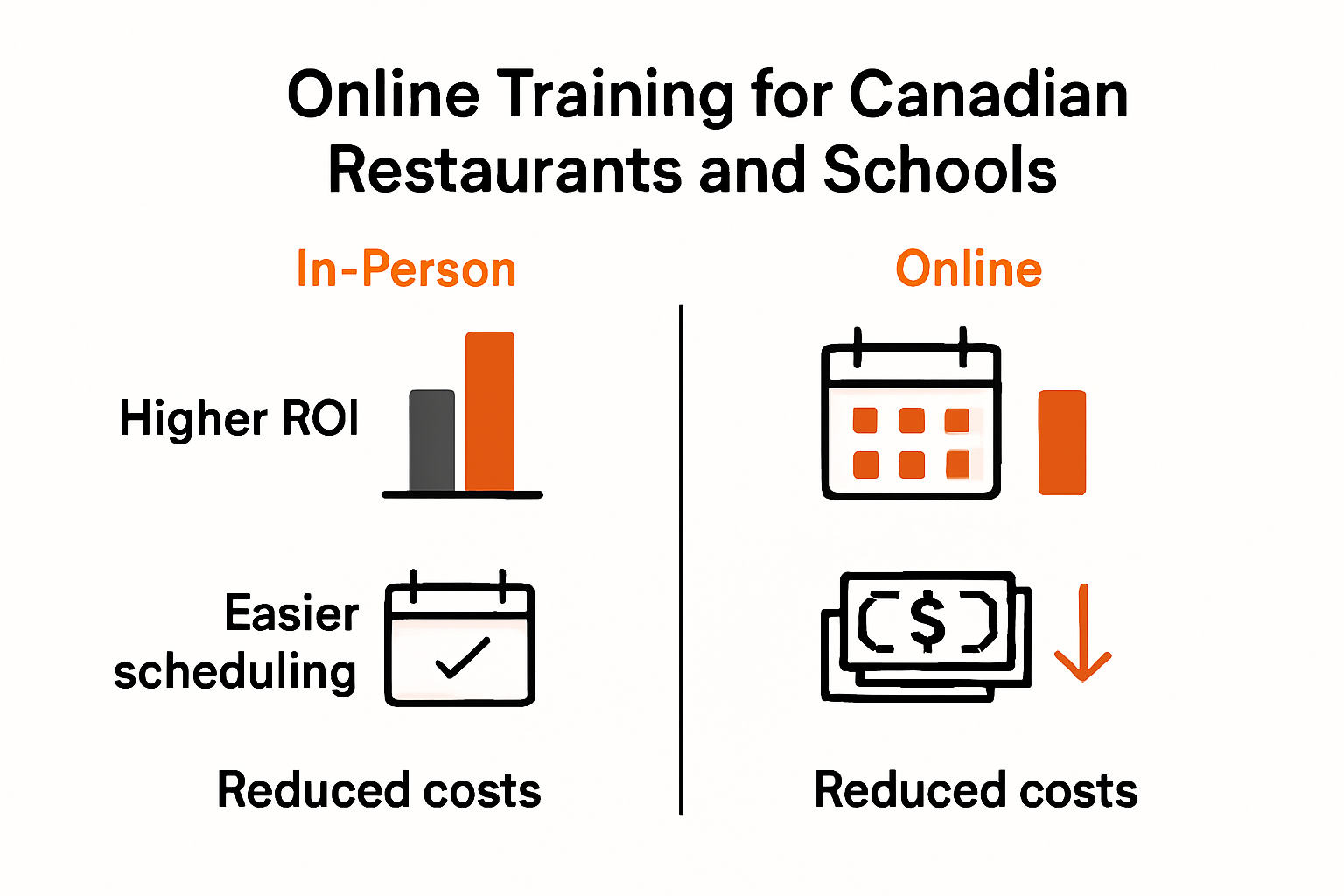
Online training represents a strategic approach for Canadian restaurants and schools to optimize their professional development resources while minimizing logistical complexities. By reimagining traditional training models, organizations can achieve substantial financial and operational efficiencies.
Traditional training programs involve significant overhead costs that online platforms effectively eliminate. According to QSR Magazine, employer sponsored education benefits can generate an impressive 226% average return on investment over three years by reducing recruitment and training expenses through improved employee retention.
The financial advantages extend beyond immediate training costs. Online platforms dramatically reduce expenses associated with physical infrastructure, printed materials, travel reimbursements, and instructor fees. Restaurant managers and school administrators can redirect these saved resources toward core operational needs, creating a more financially efficient training ecosystem.
Development and Learning in Organizations reports that many large organizations are successfully utilizing Massive Open Online Courses (MOOCs) to replace traditional training programs. This approach simplifies complex training logistics by providing standardized, accessible learning experiences across diverse organizational settings.
For restaurants and educational institutions, online training means eliminating scheduling conflicts, reducing staff coverage challenges, and creating consistent learning experiences. Employees can complete modules during off peak hours or personal time, ensuring minimal disruption to daily operations. The self paced nature of online courses allows individuals to learn at their optimal speed and convenience.
Industry case studies demonstrate remarkable efficiency gains through digital training approaches. Nation’s Restaurant News highlighted how T.G.I. Friday’s transformed its manager training program from a traditional 13 week model to an 8 week blended program incorporating online assessments, resulting in significant time savings.
This approach translates directly into operational benefits. Reduced training durations mean faster employee onboarding, quicker skill acquisition, and more immediate productivity. For restaurants facing high staff turnover and schools managing complex professional development requirements, these time efficiencies become crucial competitive advantages.
Find out how our interactive training solutions can help your organization optimize training investments and simplify learning logistics. Online training is not just a technological shift but a strategic approach to building more agile, efficient, and responsive professional development ecosystems.
To illustrate the main differences between traditional and online training for Canadian restaurants and schools, the following table summarizes cost, flexibility, and logistical factors as discussed above.
| Factor | Traditional Training | Online Training |
|---|---|---|
| Cost of Venues & Materials | High | Low |
| Instructor Fees | Needed for every session | Not always required |
| Employee Time Away from Work | Disruptive | Minimal—flexible scheduling |
| Scheduling Conflicts | Common | Rare/self-paced |
| Travel Requirements | Often required | None |
| Standardized Learning Experience | Varies by session | Consistent across locations |
Online training has emerged as a powerful tool for enhancing staff skills and ensuring regulatory compliance across restaurants and educational institutions. The digital learning landscape provides a comprehensive approach to professional development that goes beyond traditional training methods.
National Institutes of Health research demonstrates that online training significantly improves skill retention and compliance among food service workers. Digital learning platforms create immersive experiences that engage employees more effectively than conventional training approaches. Interactive modules, video demonstrations, and real time assessments ensure that staff members not only learn critical skills but also retain and apply them in their workplace environments.
For restaurants and schools, this means a more robust approach to professional development. Employees can access targeted training that addresses specific skill gaps, from food safety protocols to educational best practices. The ability to revisit content, take practice assessments, and track individual progress creates a more comprehensive learning experience.
Education Resources Information Center highlights the critical role of online training in meeting complex regulatory requirements. Educational institutions and food service businesses face increasingly stringent compliance standards, and digital training platforms provide a streamlined solution for staying current with the latest regulations.
Online training enables organizations to:
Learn more about tracking staff certifications to understand how digital platforms simplify compliance management. The ability to generate comprehensive reports and maintain up to date training records becomes significantly easier with online training solutions.
The dynamic nature of online training supports ongoing professional growth. Unlike traditional one time training sessions, digital platforms allow for continuous learning and skill enhancement. Employees can access updated content, participate in ongoing professional development, and stay current with industry best practices.
This approach is particularly valuable in rapidly evolving industries like food service and education. Staff members can quickly adapt to new technologies, updated safety protocols, and emerging best practices. The flexibility of online training means that professional development becomes an ongoing, integrated part of an organization’s culture rather than a periodic requirement.
As Canadian restaurants and schools look to the future, online training represents more than just a learning tool. It is a strategic approach to building more skilled, compliant, and adaptable workforce that can meet the complex challenges of modern professional environments.
Here is a table outlining how online training supports critical compliance and development processes for restaurants and schools, as described above.
| Compliance & Development Needs | Online Training Solution |
|---|---|
| Standardizing training across locations | Centralized digital content |
| Tracking certifications | Automated progress & certification logs |
| Meeting new regulations | Instant updates to training modules |
| Skill gap targeting | Adaptive/personalized modules |
| Continuous professional development | On-demand and ongoing access |
Online training has revolutionized professional development in hospitality and education by offering unprecedented customization and precision in learning experiences. The ability to create targeted, industry specific content transforms how professionals acquire and refine their skills in these dynamic sectors.
EHL Insights emphasizes the critical advantage of digital learning platforms in providing flexible, cost effective, and personalized educational experiences. For restaurants and schools, this means developing training content that directly addresses specific operational challenges and skill requirements.
The Information journal study highlights how tailored e-learning approaches enhance employability by closely aligning training content with real world industry demands. Digital platforms can quickly update modules to reflect emerging trends, safety protocols, and technological advancements, ensuring that learning remains current and relevant.
eLearning Industry reports significant advantages in digital training for hospitality professionals. Adaptive learning technologies enable content to be dynamically adjusted based on individual learner performance, knowledge gaps, and specific role requirements.
Key benefits of adaptive content include:
For restaurant managers and school administrators, this means training programs that are no longer one size fits all but precisely calibrated to organizational and individual needs.
Online training platforms now offer unprecedented granularity in content design. Culinary professionals can access detailed food safety modules, while educators can find specialized training in classroom management, curriculum development, and emerging pedagogical techniques.
Learn more about our interactive training approaches that make skill acquisition both targeted and engaging. The future of professional development lies in these hyper focused, technology enabled learning experiences that respond dynamically to industry evolution.

As Canadian restaurants and schools navigate increasingly complex professional landscapes, tailored online training represents more than an educational tool. It is a strategic approach to building workforce capabilities that are agile, precise, and continuously evolving.
Online training offers unmatched flexibility, cost savings, improved skill retention, and tailored content for specific industry needs, ensuring that employees can learn at their own pace without disrupting operations.
Online training significantly reduces costs related to venue rentals, materials, travel, and instructor fees, resulting in a more efficient system and an average return on investment of 226% over three years.
Online training enhances compliance by providing standardized, easily accessible content, enabling organizations to track certifications and ensure employees stay current with industry regulations and best practices.
Yes, online training platforms utilize adaptive learning technologies to create personalized learning experiences that target specific skills and knowledge gaps for various roles within the hospitality and education sectors.
Busy schedules, unpredictable shifts, and tough compliance rules make traditional training nearly impossible for restaurants and schools in Canada. If you want to save money, simplify logistics, and guarantee a safer workplace, self-paced online certification is the simple answer. Did you know flexible online courses can protect your business and boost team confidence with instant, government-accredited credentials? Discover why interactive and adaptive learning increases retention and keeps everyone up to date on workplace safety, food handling, WHMIS, and TDG requirements.

Act now to make compliance and staff development effortless. Visit Probe It Food Safety.ca to explore our affordable 24/7 food safety Food Handler Certification and workplace safety training built for Canadian restaurants and schools. Join thousands of leaders who have already switched to convenient, online solutions. Start your team’s certification journey today at Probe It Food Safety.ca and experience the future of professional development.
Exams are stressful, and the pressure of passing may leave you feeling overwhelmed and nervous that you won’t pass, even

Food safety is essential if you want to ensure safety and establish trust with your customers. Food handlers must be

Practicing good food safety habits is paramount to maintaining a healthy kitchen. Regardless of the size of your hotel business