No products in the cart.

10 Tips for Passing Your Food Handler’s Certificate Exam
Exams are stressful, and the pressure of passing may leave you feeling overwhelmed and nervous that you won’t pass, even


Canada’s off-premise food sales are growing fast and transforming how millions eat every day. More than half of all foodborne illness outbreaks start at retail food establishments, according to recent CDC data. That sounds like a crisis waiting to happen if you order takeout or delivery. Yet the real surprise is how new safety rules and tech tools are making these meals safer—and sometimes even more reliable—than food straight from the kitchen.
| Takeaway | Explanation |
| Prioritize temperature control during food delivery | Maintaining safe temperature ranges prevents bacterial growth and ensures food safety during transport. |
| Implement robust packaging to prevent contamination | Use sealed and tamper-evident packaging to protect food quality and minimize contamination risks. |
| Adopt comprehensive staff training programs. | Training staff in food safety practices empowers them to maintain compliance and enhance consumer trust. |
| Utilize advanced monitoring technology. | Real-time tracking and digital monitoring enhance food safety measures and provide transparency in processes. |
| Focus on regulatory compliance across jurisdictions | Understanding and adhering to federal and provincial regulations is essential for safe food distribution in Canada. |
Off-premise food sales have transformed the food service landscape, introducing complex safety challenges that demand rigorous attention. As food distribution becomes increasingly decentralized, understanding the inherent risks is crucial for maintaining public health and consumer trust.
Off-premise food sales involve multiple touchpoints where contamination can occur, making safety protocols more intricate than traditional restaurant environments. Learn more about food safety essentials for comprehensive protection.
According to the CDC report, most foodborne illness outbreaks originate in retail food establishments, highlighting the critical need for stringent safety measures. The transition from in-restaurant dining to delivery, takeout, and meal kit services has exponentially increased the potential for contamination.
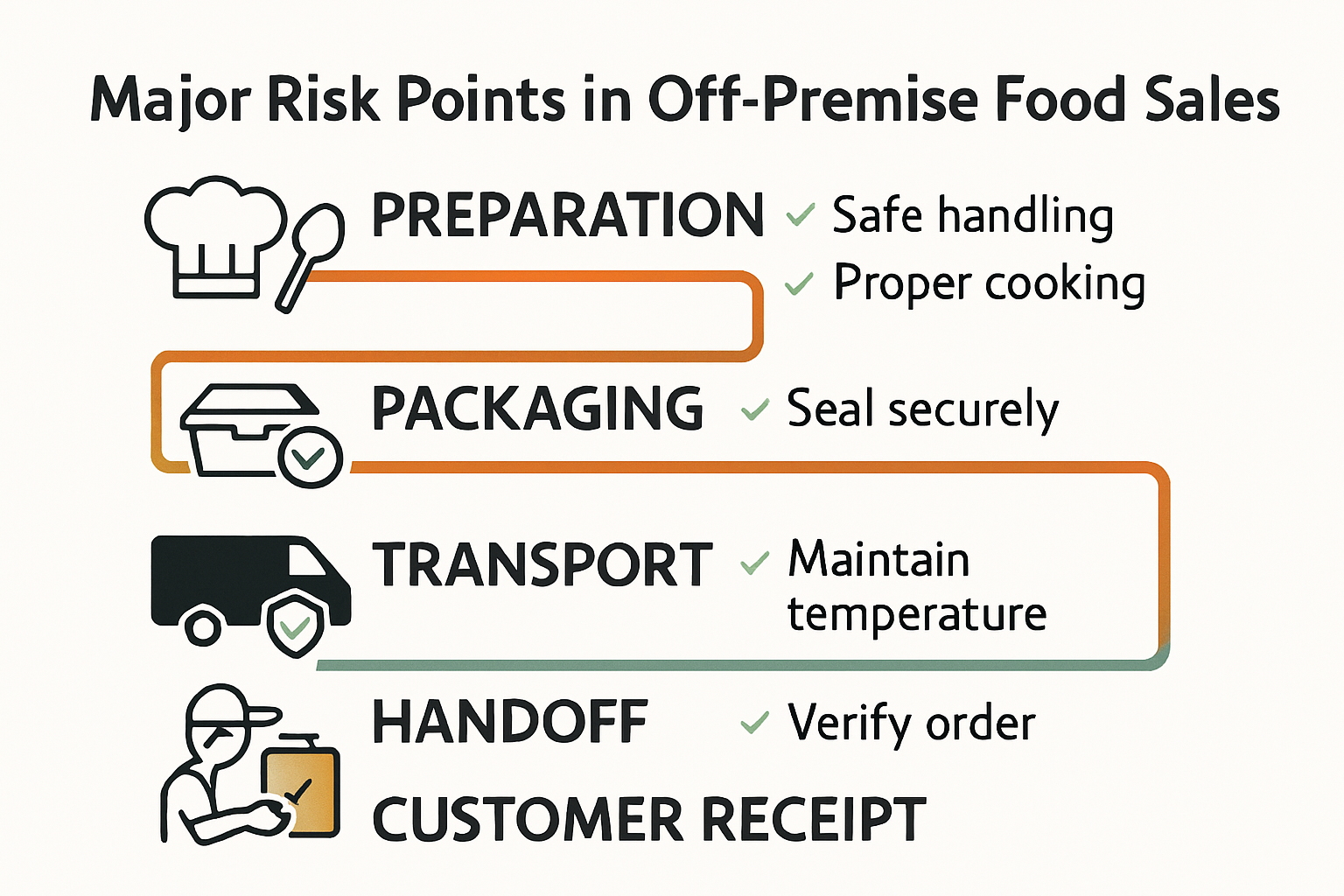
Several key risk factors emerge in off-premise food sales. Temperature control becomes paramount during transportation, as perishable foods can quickly enter the “danger zone” between 40°F and 140°F, where bacterial growth accelerates. The FDA guidance emphasizes preventive measures across the entire food system to minimize potential contamination.
Staff training and knowledge represent another significant risk area. An NSF survey identified employee turnover and a lack of comprehensive understanding of food safety as substantial challenges. This becomes even more complex in off-premise scenarios where direct supervision is limited.
Effective risk management requires a multifaceted approach combining technological solutions and human expertise. Digital temperature tracking, real-time monitoring systems, and robust training programs can significantly reduce the risk of safety breaches. Implementing comprehensive food handler certification programs ensures that every individual involved in off-premise food sales understands critical safety protocols.
The evolution of off-premise food sales demands continuous adaptation of safety strategies. Restaurants, delivery services, and food preparation facilities must collaborate to create a comprehensive safety ecosystem that protects consumer health while meeting the growing demand for convenient dining options.
Understanding these risks is not just about compliance but about building trust. As off-premise food sales continue to expand, proactive safety measures will differentiate successful food service providers in an increasingly competitive market.
Off-premise food sales in Canada require strict adherence to comprehensive regulatory frameworks designed to protect consumer health and ensure food safety standards across diverse food service environments. Learn more about critical food handling procedures to maintain compliance.
The Canadian food safety regulatory environment is primarily governed by the Canadian Food Inspection Agency (CFIA), which plays a critical role in safeguarding the nation’s food supply. According to the CFIA documentation, providers must comply with the Safe Food for Canadians Regulations, which establish mandatory requirements for food preparation, transportation, and distribution.
In December 2024, Health Canada published critical amendments to the Food and Drug Regulations, modernizing frameworks for food compositional standards and microbiological safety criteria. These updates reflect the evolving landscape of food service and off-premise sales, emphasizing science-based decision-making and addressing emerging industry challenges.
Canadian food service providers engaged in off-premise sales must maintain rigorous documentation and implement robust food safety management systems. This includes developing and maintaining Hazard Analysis Critical Control Point (HACCP) plans, which systematically identify and prevent potential food safety risks throughout the food production and distribution process.
HACCP training becomes essential for organizations seeking to meet regulatory standards. Providers must demonstrate comprehensive risk management strategies that cover temperature control, ingredient sourcing, packaging, transportation, and handling protocols.
While federal regulations provide a foundational framework, food service providers must also navigate provincial and territorial-specific requirements. Each region may have additional rules and inspection protocols that complement the federal standards. This multilayered regulatory approach ensures a comprehensive and adaptable food safety ecosystem that can respond to local and regional variations in food service practices.
Successful off-premise food sales in Canada demand a proactive approach to regulatory compliance. Providers must invest in continuous staff training, implement advanced tracking and monitoring systems, and maintain meticulous records that demonstrate ongoing adherence to safety standards. By embracing these comprehensive regulatory requirements, food service organizations can build consumer trust and contribute to Canada’s robust food safety infrastructure.
To better understand the main components of the regulatory landscape, the following table summarizes federal, provincial, and documentation requirements discussed above.
| Regulatory Area | Key Requirements |
| Federal (CFIA, Health Canada) | Safe Food for Canadians Regulations, Food and Drug Regulations, Compositional & Microbiological standards |
| Provincial/Territorial | Regional regulations, inspection protocols, and additional local requirements |
| Documentation & Compliance | HACCP plans, risk management strategies, continuous staff training, monitoring, and meticulous record-keeping |
Off-premise food sales require meticulous attention to safety protocols during delivery and pickup. As food service models continue to evolve, implementing comprehensive safety strategies becomes paramount for protecting consumer health and maintaining food quality. Explore safe takeout and delivery practices to ensure optimal food safety.
Temperature management represents the most critical aspect of off-premise food safety. According to USDA guidelines, perishable foods must not remain at room temperature for more than 2 hours, with stricter limits when ambient temperatures exceed 90°F. Hot foods should be maintained at 140°F or above, while cold foods must be kept at 40°F or below.
Food service providers must invest in specialized transportation equipment that maintains precise temperature ranges. Insulated containers, thermal bags, and digital temperature-monitoring systems help ensure that food remains within safe temperature parameters throughout delivery and pickup. These technological solutions provide real-time tracking and documentation of food safety compliance.
Safe packaging represents another crucial element in off-premise food sales. Containers must be designed to prevent cross-contamination, maintain food temperature, and preserve food quality. Sealed, tamper-evident packaging with appropriate compartmentalization helps minimize bacterial growth and protect food from external contamination.
The CDC recommends consumers verify restaurant inspection scores and pay attention to packaging integrity. Food service providers should implement rigorous quality control measures, including visual inspections and staff training on proper packaging techniques.
The ongoing global health landscape has accelerated the adoption of contact-free delivery and pickup methods. These strategies not only enhance consumer convenience but also provide additional layers of food safety protection. Digital ordering platforms, touchless payment systems, and designated pickup zones minimize direct human interaction and reduce potential contamination risks.
Training delivery personnel and pickup staff becomes essential in maintaining these safety protocols. Comprehensive hygiene practices, including frequent hand sanitization, the use of protective equipment, and adherence to strict cleaning guidelines, help mitigate potential transmission risks.
Successful off-premise food sales in 2025 will require a holistic approach that combines technological innovation, rigorous training, and adaptive safety strategies. By prioritizing temperature control, packaging integrity, and contact-free service models, food providers can build consumer confidence and establish robust safety frameworks for the evolving food service ecosystem.
The following table compares key best practices for off-premise food delivery and pickup, as outlined in the previous sections.
| Best Practice | Purpose | Tools/Techniques Used |
| Temperature Control | Prevent bacterial growth, ensure freshness | Insulated containers, thermal bags, and digital monitoring |
| Robust Packaging | Prevent contamination, maintain quality | Sealed/tamper-evident packaging, compartmentalization |
| Contact-Free Methods | Reduce contact, minimize transmission risks | Digital ordering, touchless payment, designated zones |
| Staff Training | Ensure correct handling and safety | Comprehensive training, hygiene protocols |
Off-premise food sales in Canada require strict adherence to comprehensive regulatory frameworks designed to protect consumer health and ensure food safety standards across diverse food service environments. Learn more about critical food handling procedures to maintain compliance.
Effective staff training goes beyond traditional instruction methods, incorporating advanced technological solutions and interactive learning approaches. The ISO 22000 international standard provides a comprehensive framework for food safety management, emphasizing the critical role of staff education in maintaining food safety across the entire supply chain.
Modern training programs must address multiple dimensions of food safety, including temperature control, cross-contamination prevention, personal hygiene, and proper handling techniques specific to off-premise food sales. National food safety training programs offer a standardized curriculum that ensures consistent knowledge and skill development across different food service environments.
Emergent technologies are transforming food safety monitoring capabilities. The innovative FINDER model, a machine-learned system, demonstrates how advanced data analysis can enhance real-time detection of potential foodborne illness risks. This approach combines web search data, location information, and predictive analytics to identify potential safety concerns before they escalate.
Digital tracking systems, including temperature monitoring devices, QR code-based traceability, and real-time reporting platforms, provide unprecedented visibility into food safety processes. These technologies enable rapid response to potential contamination risks and create transparent documentation of safety protocols.
A 2025 industry report highlights significant challenges in food safety monitoring, including reduced inspections and budget constraints. This underscores the importance of developing adaptive, resilient training and monitoring strategies that can respond to changing operational landscapes.
Successful food safety monitoring requires a holistic approach that combines ongoing staff education, technological innovation, and proactive risk management. Organizations must foster a culture of continuous learning, empowering staff to identify and address potential safety risks immediately.
Implementing comprehensive staff training and advanced monitoring systems is not just a regulatory requirement but a critical investment in consumer trust and organizational reputation. By prioritizing these elements, food service providers can create safer, more reliable off-premise food sales experiences that meet the highest standards of quality and safety.

Off-premise food sales face several risks, including temperature control issues, potential cross-contamination during packaging and delivery, and the need for comprehensive staff training to ensure safety protocols are followed.
Restaurants can ensure food safety by maintaining proper temperature control, using robust packaging to prevent contamination, and adopting contact-free methods to minimize direct contact during delivery and pickup.
Canadian food providers must comply with the Safe Food for Canadians Regulations, maintain Hazard Analysis Critical Control Point (HACCP) plans, and adhere to federal, provincial, and territorial food safety regulations that govern food preparation, transportation, and distribution.
Staff training is crucial for maintaining food safety in off-premise sales. Comprehensive training programs ensure that staff are knowledgeable about safety protocols, including proper food handling, temperature control, and contamination prevention, which ultimately protects consumer health.
You just learned how small food safety mistakes in off-premise sales can lead to big problems for Canadian businesses. The article highlights critical risks like loss of temperature control, packaging contamination, and the urgent need for proven staff training. For restaurants, caterers, and food delivery services, these challenges create constant pressure to stay compliant with federal and provincial rules and to protect your customers every single time an order leaves your kitchen. If you want peace of mind and fewer compliance headaches, Probe It Food Safety.ca is here to help you build dependable safety into your daily operations.

Thousands across Canada use Probe It Food Safety.ca for certified Food Handler Certification and industry-leading training designed by public health experts. Fast-track your compliance and empower your whole team 24/7 with flexible, government-recognized courses that keep up with the evolving requirements examined in this guide. Visit Probe It Food Safety.ca now and protect your reputation by making food safety your strongest link.
Outdoor Food Service Safety Tips for Canadian Businesses 2025 – Probe It Food Safety
Food Safety Standards in Canada: What Restaurants and Schools Need for 2025 – Probe It Food Safety
Top Food Safety Tips for Managers: 2025 Guide for Canadian Businesses – Probe It Food Safety
Food Safety Basics 2025: A Guide for Canadian Kitchens – Probe It Food Safety
Importance of Notarized Documents for Ontario Businesses 2025 – My Mobile Notary
Exams are stressful, and the pressure of passing may leave you feeling overwhelmed and nervous that you won’t pass, even

Food safety is essential if you want to ensure safety and establish trust with your customers. Food handlers must be

Practicing good food safety habits is paramount to maintaining a healthy kitchen. Regardless of the size of your hotel business