

No products in the cart.
How Long Do Eggs Last in the Fridge?
Two Canadian authorities publish two different numbers for eggs in the shell, and both are right. Here is the full egg clock, from the carton to the hard-boiled ones in the daycare fridge, and the one check no float test can do.
Quick answer
Eggs in the shell last 3 weeks in the fridge at 4°C (40°F) or lower under the provincial food handler guide, or until the best before date (3 to 4 weeks) under Health Canada. Hard-boiled eggs last 1 week. Cooked egg dishes last 3 to 4 days. Raw eggs out of the shell last 2 to 4 days. Keep eggs in the carton, cook egg dishes to 74°C (165°F), and if in doubt, throw it out.
Hello, Samira here again. I have been inspecting kitchens since 2009, and eggs are the food people are most confident about and most often wrong about. They sit in the door, they get cracked into a bowl the night before, and a dozen with two chipped shells still gets used because the rest look fine. Let us go through what the Canadian sources actually say, and where the two main sources give different numbers.
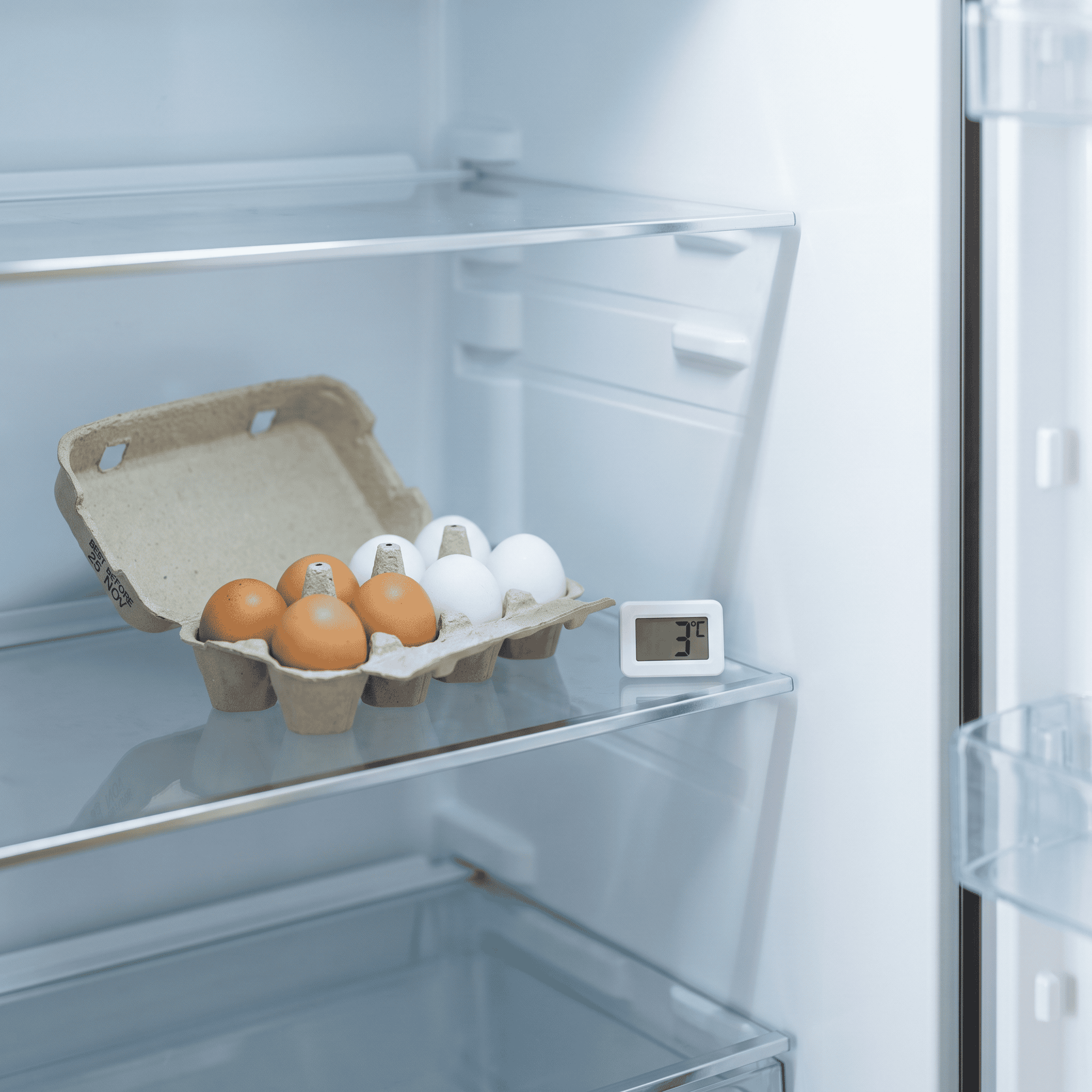
Egg storage times in the fridge and freezer
Two Canadian government sources publish egg storage numbers. The Ontario food handler guide (Appendix H) is the chart provincial inspectors and most food premises across Canada use, and most provinces publish equivalent numbers. Health Canada publishes a home storage chart in its Safe Food Handling guides for children under 5 and for pregnant women. Both charts assume a fridge at 4°C (40°F) or lower and a freezer at minus 18°C (0°F) or lower.
| Egg or egg food | Fridge (4°C or lower) | Freezer (minus 18°C) | Source |
|---|---|---|---|
| Eggs in the shell | 3 weeks | Do not freeze | Ontario handler guide, Appendix H |
| Eggs in the shell | By best before date, or 3 to 4 weeks | Do not freeze | Health Canada, Safe Food Handling |
| Raw egg out of the shell (whites or yolks) | 2 to 4 days | 4 months | Health Canada; Ontario guide (freezer) |
| Hard-boiled eggs | 1 week | Do not freeze | Health Canada, Safe Food Handling |
| Cooked egg dishes (quiche, frittata, scrambled) | 3 to 4 days | 2 to 3 months | Health Canada, Safe Food Handling |
| Deli or homemade salads (includes egg salad) | 3 to 5 days | Do not freeze | Health Canada, Safe Food Handling |
| Opened egg substitutes | 3 days | Do not freeze | Health Canada, Safe Food Handling |
These numbers are maximums, not targets. A restaurant, hospital, or care home running its own HACCP plan will often discard sooner, and that is a business choice, not the regulation. If an egg smells off, leaks, or sticks to the carton, the clock does not matter. Throw it out.
Why eggs get their own rules
Eggs are a potentially hazardous food under Ontario rules, in the same group as meat, fish, and poultry. The provincial guide puts it plainly: any food that contains eggs is also potentially hazardous. That is why a quiche, a custard, and a mayonnaise all follow the egg clock, not the vegetable clock.
What makes eggs different from a steak is the shell. A whole raw egg in an intact shell keeps for weeks. The moment the shell is cracked, the egg becomes a 2- to 4-day food. Most home mistakes I see come from treating a bowl of cracked eggs like a carton of whole ones.
The other difference is where the bacteria live. Salmonella is often found in poultry products, and the Ontario guide lists chicken, turkey, and eggs together. A cracked or dirty shell gives that bacteria a path inside, which is why Halton Region singles out cracked eggs as a Salmonella food. The rest of this article follows that thread.
Are eggs still good after 1, 2, or 3 months?
No. Health Canada says to use eggs in the shell by the best before date or within 3 to 4 weeks. The Ontario handler guide says 3 weeks. Neither source gives a safe window past that. If your carton is 2 months old, it is outside the window on both charts. Discard it.
People ask me about the float test. An egg floats because the air cell inside grows as the egg ages. That tells you the egg is old. It cannot tell you whether Salmonella is inside. No Canadian public health source uses the float test as a safety check, and neither do I. Use the date on the carton, and if in doubt, throw it out.
Scrambled eggs, quiche, and egg salad
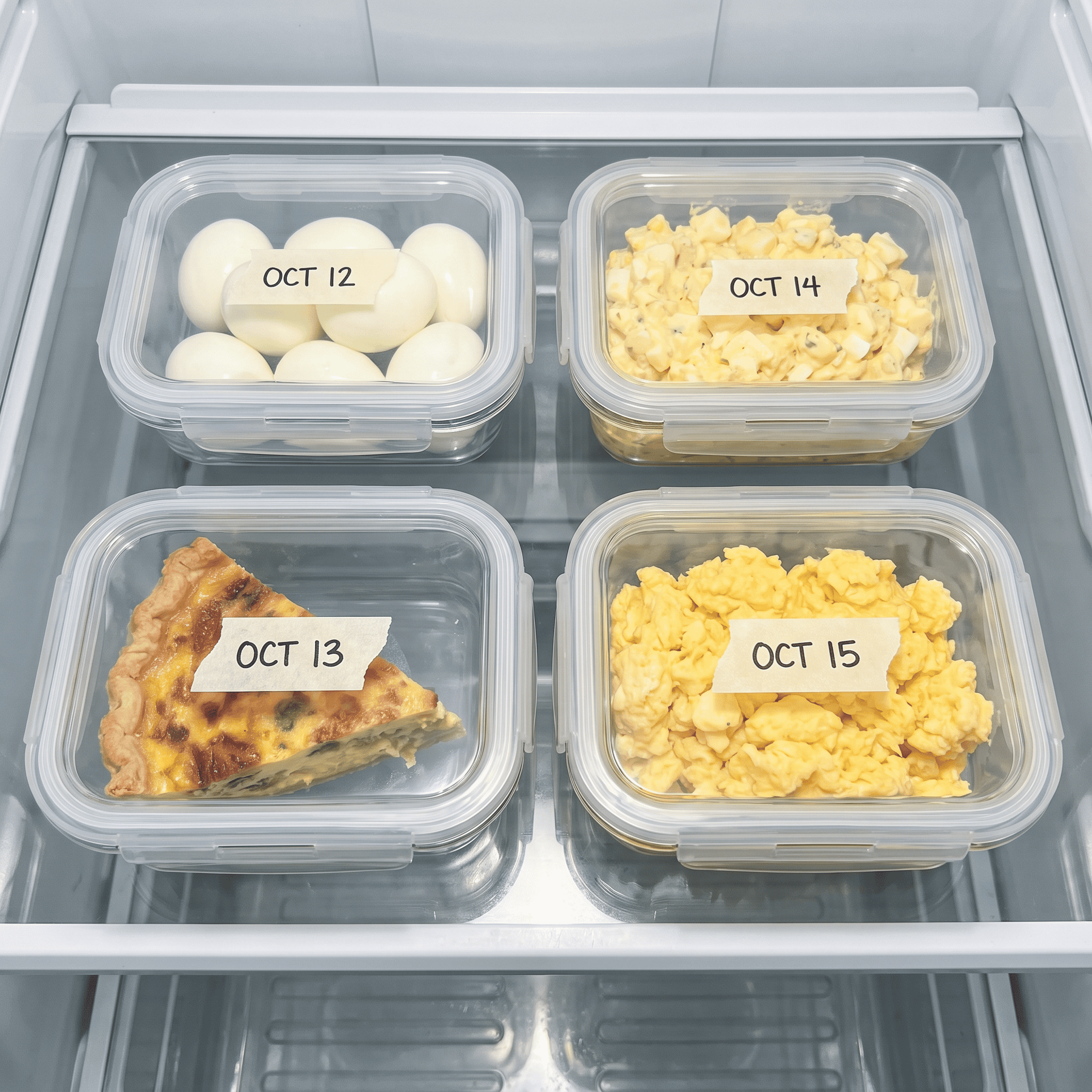
Once eggs are cooked, they follow the leftovers clock. Health Canada lists cooked egg dishes as safe for 3 to 4 days in the fridge and 2 to 3 months in the freezer. Scrambled eggs, omelettes, frittatas, and quiche all fit that row. Cool within 2 hours, cover, and reheat to 74°C (165°F).
Hard-boiled eggs get 1 week, in the shell or peeled. Egg salad is a homemade salad, and Health Canada lists deli or homemade salads at 3 to 5 days. In practice, the mayonnaise, chopping, and handling mean I treat egg salad as a 3-day food in any kitchen I inspect, and 5 days is the outer limit at home.
Salmonella: which meal made you sick
The germ tied to eggs is Salmonella. The Ontario handler guide lists the usual sources as raw poultry, pork, and the feces of infected people, and the usual foods as poultry, meat, unpasteurized milk, egg products, and raw eggs. Symptoms are fever, abdominal pain, diarrhea, nausea, vomiting, and dehydration.
Here is the part most people get wrong. Symptoms start 6 to 72 hours after eating, and usually 18 to 36 hours. So when someone is sick on Tuesday night, the eggs from Tuesday breakfast are rarely the cause. It is more often Monday's meal, sometimes Sunday's. When I investigate a complaint, the last thing eaten is the first thing people blame and the least likely answer.
Health Canada names the people at highest risk from raw or lightly cooked eggs: children under 5, pregnant women, older adults, and anyone with a weakened immune system. For those groups, the safer alternatives are egg dishes cooked to 74°C (165°F) with a firm yolk, and no raw egg in dressings, cookie dough, cake batter, sauces, or homemade eggnog. Heat eggnog to 71°C (160°F).
Cooking temperatures for eggs
Health Canada's safe cooking temperatures chart sets egg dishes such as frittata, omelette, and quiche at 74°C (165°F). Ontario Regulation 493/17 says any food mixture containing egg, poultry, meat, or fish must reach at least 74°C for at least 15 seconds in all parts of the mixture, and the same temperature applies when you reheat it. Most provinces set the same target.
| Egg food | Internal temperature | Source |
|---|---|---|
| Egg dishes (frittata, omelette, quiche, casserole) | 74°C (165°F) | Health Canada cooking chart |
| Any food mixture containing egg | 74°C for at least 15 seconds | O. Reg. 493/17, s. 27(5) |
| Reheated egg dish or leftovers | 74°C in all parts | Peel Region, Appendix G |
| Homemade eggnog | 71°C (160°F) | Health Canada, Safe Food Handling |
A probe thermometer in the centre of the quiche is the only way to know. Colour is not a test. Keep it in mind when the next section covers freezing, because a thawed egg dish still needs the same 74°C on the way back up.
Freezing and thawing eggs
Never freeze eggs in the shell. Both charts say do not freeze. Crack them, beat the whites and yolks together or freeze them separately, and label the container. The Ontario guide gives frozen whites and yolks 4 months at minus 18°C; Health Canada gives the same. Cooked egg dishes freeze for 2 to 3 months. Hard-boiled eggs and egg salad do not freeze.
Thaw frozen eggs in the fridge, not on the counter. Once thawed, it is a raw egg out of the shell again, so use it within 2 to 4 days and cook it to 74°C. Do not refreeze it.
Where eggs go in the fridge
The Ontario guide says to refrigerate eggs as soon as you receive them and store them in their original containers. The carton is not packaging you can throw away. It carries the best-before date, keeps the shells from cracking, and keeps the eggs from picking up odours. If eggs are shipped from a grading station, the regulation allows transport at 13°C (55°F), but as soon as they arrive, they go into the fridge at 4°C or lower.
Raw eggs are a raw animal product. The provincial guide's rule for avoiding cross-contamination is separate equipment, utensils, cutting boards, and preparation areas for raw and ready-to-eat food. In a fridge, that means the carton sits on a shelf below ready-to-eat food, never above the salad or the cooked chicken. For the full shelf order, the fridge storage guide covers every food on one chart.
Grade A, cracked eggs, and the food premises rule
Every egg sold in a Canadian grocery store is graded Canada A. In a food premise, the rules are stricter than at home. Ontario Regulation 493/17, section 47, says no operator of a food premise shall store, handle, serve, process, prepare, display, distribute, transport, sell, or offer for sale ungraded or Grade C eggs. The handler guide translates it: cracked eggs and Grade C eggs cannot be used in food premises. Most provinces have an equivalent rule.
The guide tells handlers to check inside every carton for cracks, feathers, or feces. Any of those makes the egg Grade C, and Grade C eggs may carry Salmonella. Liquid eggs must be pasteurized, and their packaging cannot be broken or damaged. Duck, quail, and other non-hen eggs must arrive clean, uncracked, and be stored at 4°C or lower.
At home, you are allowed to buy ungraded eggs straight from a farm for your own use. You may also crack a chipped egg into your own pan. I would not. A cracked shell is the shortest path for bacteria into the egg, and a dozen eggs is not worth a night of the symptoms listed above. Throw the cracked one out and keep the rest.
A daycare fridge on inspection day
Picture a daycare kitchen that serves 40 children under 5. Health Canada puts every one of those children in the high-risk group for eggs. The cook boils three dozen eggs on Monday for snacks through the week and cracks a bowl of eggs on Sunday night for Monday's breakfast bake. Nothing is labelled. This is the fridge I open more often than any other, and here is how the government numbers turn into a working plan.
| Step | What the cook does | Why it matters |
|---|---|---|
| 1. Receive | Check every carton for cracks, feathers, or feces. Refuse the carton if any egg fails. Fridge within minutes, at 4°C or lower. | Grade C eggs are banned in a food premises under O. Reg. 493/17 s. 47 |
| 2. Label | Write the boil date on the hard-boiled egg container. Discard on day 7 at the latest. | Health Canada gives hard-boiled eggs 1 week |
| 3. Crack fresh | Crack eggs the morning of the bake, not the night before. If a bowl must be held, it is a 2 to 4 day food and gets a date. | Raw egg out of the shell is a 2 to 4 day food |
| 4. Cook and probe | Bake to 74°C in the centre, firm yolks, and record the reading. | Children under 5 are a high-risk group for Salmonella |
| 5. Tighten the clock | Under its HACCP plan, the daycare discards egg dishes at 2 days, not 4. | HACCP plans go above the regulation for high-risk groups. That is the plan, not the law |
| 6. Train the team | Every cook and every helper holds a food handler certificate. Group seats are bought in one order. | The group registration page handles the whole team at once |
Step 5 is the one people push back on. The regulation does not require a 2-day limit on quiche. The daycare chooses it because a Salmonella case in a toddler is not a small thing. HACCP goes above and beyond the government rule on purpose, and an inspector will respect a tighter clock every time.
"The carton is the record. Throw the carton away, and you have thrown away the date, the padding, and your answer when I ask how old the eggs are."
Samira AliCertified Public Health Inspector, inspecting kitchens since 2009
Three real situations
The carton is 5 days past the best before date.
Health Canada says to use by the best before date or within 3 to 4 weeks. Five days past the date is outside the window. Discard the carton. A dozen eggs costs less than 18 to 36 hours of Salmonella.
Peeled hard-boiled eggs from last weekend
Hard-boiled eggs are good for 1 week, peeled or in the shell. If they were boiled Saturday and today is Friday, they are on day 6 and still inside the window. Sunday, they are out. If you cannot remember which day you boiled them, that is the answer.
Egg salad for the lunch bag
Homemade salads get 3 to 5 days in the fridge. Egg salad made Sunday night is fine for Monday and Tuesday lunches. It also needs to stay cold in the bag, because once it leaves the fridge, the 2-hour limit for eggs at room temperature takes over.

Know every clock in the fridge, not just the egg one
The food handler course covers storage times, cooking temperatures, and Salmonella control for every food you serve. Register in 30 seconds and certify in as little as 6 hours.
Register Now4.8 / 5 from 1,711 verified reviews
Frequently asked questions
How long do eggs last in the fridge in Canada?
Eggs in the shell last 3 weeks at 4 degrees Celsius or lower under the provincial food handler guide, or until the best before date or 3 to 4 weeks under Health Canada. Once cracked, a raw egg lasts 2 to 4 days. Keep eggs in the original carton and check the date before use.
Are eggs still good after 2 months in the fridge?
No. Both Canadian charts stop at 3 to 4 weeks or the best before date. A 2-month-old carton is well outside that window and should be discarded. Age alone is a reason to throw eggs out, even if they look and smell normal, because Salmonella gives no warning.
How can you tell if eggs have gone bad?
Do not use an egg that is cracked, leaking, or stuck to the carton, and discard any carton past its best-before date. A bad smell when you crack it is a clear sign. The float test only shows age, not safety, so it cannot clear an egg. If in doubt, throw it out.
How long do scrambled eggs last in the fridge?
Cooked egg dishes, including scrambled eggs, last 3 to 4 days in the fridge at 4 degrees Celsius or lower, according to Health Canada. Cool them within 2 hours of cooking, store them covered, and reheat to 74 degrees Celsius before eating. They freeze for 2 to 3 months.
How long do hard-boiled eggs last in the fridge?
According to Health Canada, hard-boiled eggs last 1 week in the fridge, in the shell or peeled. Write the boil date on the container. Do not freeze hard-boiled eggs. If you cannot remember the day they were cooked, discard them.
Can a restaurant use cracked eggs?
No. Under Ontario Regulation 493/17, section 47, a food premises cannot store, prepare, serve, or sell ungraded or Grade C eggs, and cracked eggs count as Grade C. Most provinces have an equivalent rule. Liquid eggs used in a food premises must be pasteurized.
How long after eating bad eggs do you get sick?
Salmonella symptoms usually start 18 to 36 hours after eating, and can begin anywhere from 6 to 72 hours. The meal that caused the illness is often the day before, not the last one eaten. Symptoms include fever, stomach pain, diarrhea, nausea, and vomiting.
This article is general food safety information drawn from Canadian federal and provincial public health sources. It is not legal advice. Storage times are maximums at 4°C or lower and assume proper handling. Rules differ by province and by facility, so confirm requirements with your local public health unit. Questions: info@probeit.ca.