No products in the cart.

10 Tips for Passing Your Food Handler’s Certificate Exam
Exams are stressful, and the pressure of passing may leave you feeling overwhelmed and nervous that you won’t pass, even


Every Canadian restaurant faces the challenge of keeping food safe while also meeting strict legal requirements. Food handler certification is not just a formality, it is a legal necessity driven by provincial laws designed to protect public health. Food handler exams focus on practical safety knowledge, covering temperature control, hygiene, cross-contamination, and more, with a required minimum score of 70 percent in most provinces. This introduction clarifies how understanding the exam process helps you meet compliance standards and safeguard your workplace every day.
| Point | Details |
|---|---|
| Certification is Mandatory | Food handler certification is legally required across Canada for all individuals directly handling food to ensure public health safety. |
| Exam Coverage | The food handler exam evaluates knowledge on practical safety topics, including temperature control, cross-contamination prevention, and personal hygiene. |
| Provincial Variations | Certification standards, including passing scores and certificate validity, vary by province; it’s essential to understand local requirements. |
| Preparation is Key | Effective study plans and practice tests significantly increase the likelihood of passing the exam on the first attempt. |
Food handler certification is mandatory across Canada for anyone working directly with food. Whether you’re starting your first shift or managing a restaurant team, understanding the exam process is your foundation for workplace compliance and public health protection.
The certification requirement exists because foodborne illness outbreaks carry serious consequences. Canadian health authorities mandate that food industry workers complete training based on Canadian food safety standards and demonstrate competency through a formal assessment. Without this certification, you cannot legally work with food in most Canadian provinces.
Food handler exams focus on practical safety knowledge, not theory you’ll forget. The assessment evaluates your understanding of core topics:
Food safety principles and hygiene standards form the backbone of these assessments. Most Canadian jurisdictions require a minimum score of 70% to pass.
The exam structure varies slightly by province, but most follow a consistent pattern. You’ll typically answer between 40 to 50 multiple-choice questions within a set timeframe, usually 60 to 90 minutes.
Scoring is straightforward:
Your certificate proves you understand food safety at the level required by Canadian public health regulations, protecting both customers and your business from liability.
Many Canadian training providers now offer online exams, making the process flexible and accessible. You can complete your food handler certification on your schedule, 24 hours a day, 7 days a week.

Don’t treat the exam as a surprise. Smart preparation dramatically improves your confidence and pass rate. Most providers offer study materials, practice tests, and review guides before your actual assessment.
Review the learning materials thoroughly. Take advantage of practice tests to identify weak areas. These aren’t shortcuts; they’re opportunities to learn the material properly before your official exam.
Pro tip: Set aside 2 to 3 hours for exam preparation across several days rather than cramming the night before. Spaced learning improves retention and helps you apply knowledge on the job, not just pass the test.
Canada doesn’t have a single national food handler exam. Instead, each province sets its own standards, training requirements, and certification processes. This means the exam you take in Ontario differs from the one in British Columbia or Alberta.
Understanding your province’s specific requirements is crucial before you sit for your exam. What passes in one province might not meet standards elsewhere, so knowing your local regulations prevents wasted time and effort.
In Ontario, food premises must have certified handlers on-site during all operating hours. The Ministry of Health recognises training from both local public health units and approved commercial programs.
Ontario’s approach means you have flexibility in choosing your training provider, but all providers must deliver content meeting provincial standards. This gives restaurants options while maintaining consistent food safety knowledge across the province.
Every Canadian province manages food handler certification differently. Key variations include:
Some provinces require multiple certification levels for different roles, such as basic handlers versus supervisory positions. Others accept online training exclusively, while some require in-person classroom attendance.
Here’s a quick guide to how food handler exam standards differ across major provinces:
| Province | Passing Score | Certificate Validity | Training Format |
|---|---|---|---|
| Ontario | 70% | 5 years | Online or classroom |
| British Columbia | 70% | 5 years | Online or classroom |
| Alberta | 70% | 3 years | Online or classroom |
| Quebec | 60% | 3 years | In-person only |
| Manitoba | 70% | 5 years | Online or classroom |
Your province’s specific requirements aren’t suggestions—they’re legal obligations. Operating without proper certification exposes your restaurant to fines, closure orders, and liability for foodborne illness incidents.
Before enrolling in any course, verify what your province actually requires. Each provincial health ministry publishes current standards online.
Look for:
This 10-minute check saves you from taking a course that doesn’t meet local standards.
Pro tip: Contact your provincial health unit directly if online information seems outdated. Requirements change periodically, and getting confirmation ensures you complete the right certification for your location and role.
Food handler certification isn’t optional in Canada. Provincial regulations require it as a legal condition for operating food service establishments. This isn’t bureaucratic red tape—it’s a public health mandate designed to prevent foodborne illness outbreaks.
Each province enforces certification through health and safety legislation. Violating these requirements can result in fines, operational shutdowns, and personal liability if someone gets sick from food mishandling at your establishment.
Provincial regulations require food handlers to be certified through approved training programs. The legal foundation rests on minimising health risks associated with foodborne illnesses by ensuring all food workers understand safe practices.
Think of certification as proof you meet the standard of care expected by law. Without it, you’re operating outside legal compliance regardless of how careful you actually are in practice.
Certification requirements vary by role and province, but generally apply to anyone handling food directly:
Some positions, like dishwashers or delivery drivers, may have different requirements depending on your province. Always verify your specific role with local health authorities.
Operating without proper food handler certification creates serious legal exposure:
Legal compliance isn’t just protecting your business—it’s protecting your customers from preventable foodborne illness. Certification demonstrates you take that responsibility seriously.
Certification isn’t permanent. Most provinces require renewal every two to three years. Staying current means monitoring your expiry date and scheduling retraining before your certificate lapses.
Letting certification expire puts you back in non-compliance status, regardless of how long you’ve been certified previously.
Pro tip: Set calendar reminders six months before your certification expires so you have time to complete renewal training without rushing or risking operational gaps.
Passing your food handler exam isn’t about memorising obscure facts. It’s about understanding practical food safety principles you’ll actually use on the job. The good news is that most candidates pass on their first attempt when they prepare properly.
The exam tests whether you can identify real-world food safety hazards and respond correctly. Your goal is understanding the “why” behind food safety rules, not just memorising answers.
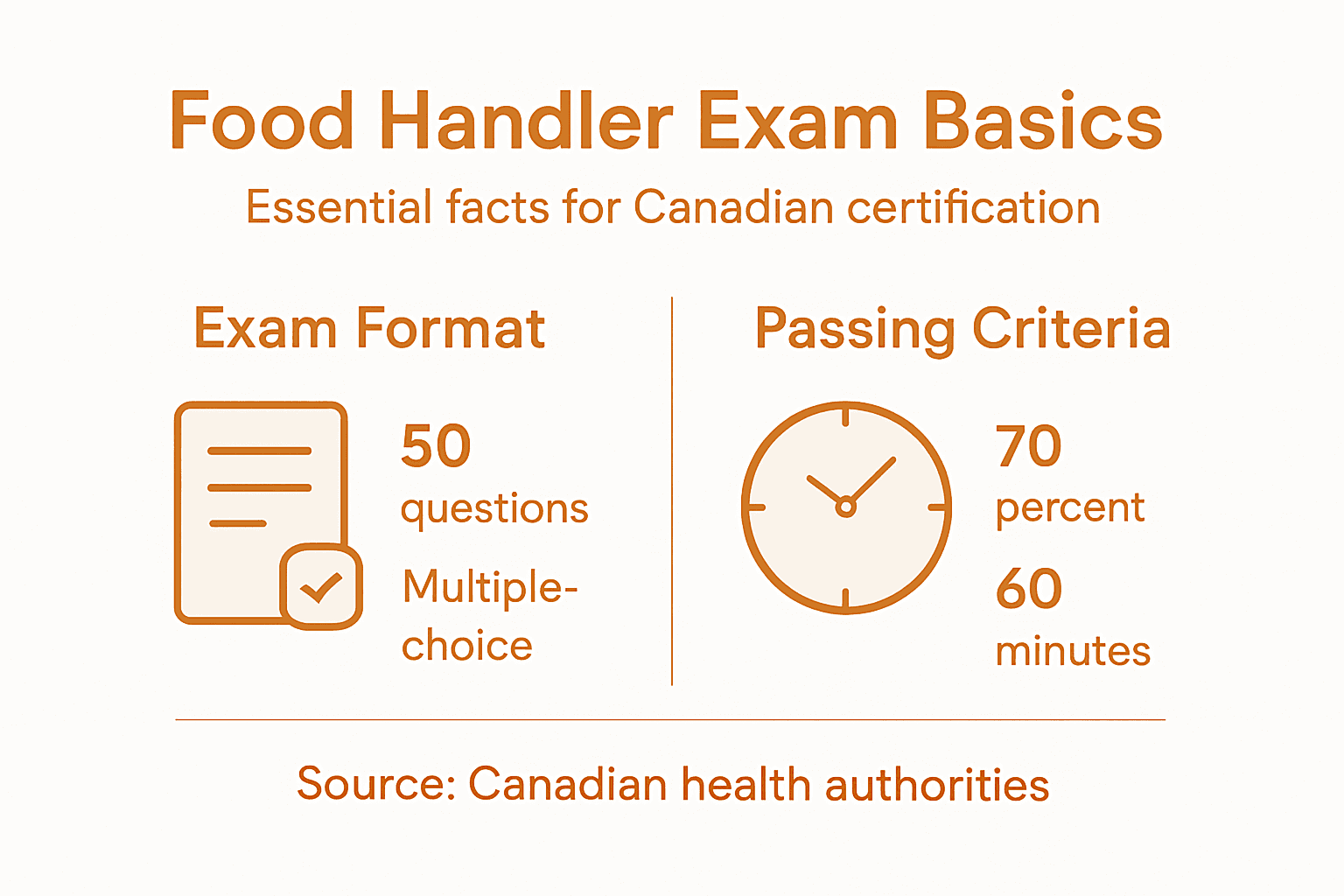
Most Canadian food handler exams follow a consistent format. The exam contains 50 multiple-choice questions with a 60-minute time limit, requiring a minimum of 70% to pass.
This structure gives you about one minute per question, so pacing matters. You’re not racing against the clock if you’ve prepared adequately.
Your preparation should focus on these practical areas:
These aren’t abstract concepts—they’re daily responsibilities in your kitchen. Understanding them deeply makes the exam straightforward.
Don’t cram everything into one night. Spread your preparation across one to two weeks instead.
Here’s a practical approach:
This approach builds knowledge gradually rather than overwhelming your brain with too much information at once.
Practice quizzes reveal your actual weak points, preventing you from wasting time studying material you already know well.
Practice exams aren’t just for confidence—they’re diagnostic tools. When you answer a question incorrectly, dig into why you got it wrong.
Was it because you misread the question? Did you lack the underlying knowledge? Understanding your error type helps you avoid it on exam day.
When you sit for the actual exam, read each question carefully before answering. Many candidates miss questions because they rushed through the wording.
If a question stumps you, flag it and move forward. Don’t spend five minutes on one difficult question when you could answer others first. You can return to flagged questions if time remains.
Pro tip: Take the exam when you’re alert and rested, ideally in the morning. Your brain performs better on food safety decisions when you’re not fatigued, and test anxiety is lower when you’re well-rested.
Even certified food handlers slip up. The difference between a safe operation and a foodborne illness outbreak often comes down to consistency. Small shortcuts compound into serious compliance failures.
Knowing what trips up other restaurants helps you avoid the same pitfalls. Most mistakes aren’t complicated—they’re habits that develop when vigilance drops.
Inadequate refrigeration temperature maintenance is one of the most frequent violations. Food handlers assume if it’s in the fridge, it’s safe. Reality is different.
Refrigerators must stay between 0°C and 4°C. Many restaurants don’t monitor temperatures regularly, allowing equipment drift that goes unnoticed for days. Use thermometers to check actual temperatures, not just dial readings.
Freezer temperatures should stay at negative 18°C or colder. Even small temperature rises dramatically accelerate bacterial growth.
Ignoring safe thawing procedures and improper storage are common errors that increase foodborne illness risk. Never thaw frozen meat on a counter. This allows surface bacteria to multiply while the interior stays frozen.
Safe thawing happens three ways:
Using airtight storage containers prevents cross-contamination and extends shelf life. Label everything with dates to catch expired items before they reach plates.
Here is a summary of common compliance failures and their business impact:
| Compliance Error | Common Cause | Impact on Business |
|---|---|---|
| Poor temperature control | Infrequent thermometer checks | Increased spoilage risk |
| Unsafe thawing practices | Thawing on counters | Foodborne illness outbreaks |
| Inadequate handwashing | Busy work pace | Higher contamination rates |
| Improper food separation | Shared equipment | Cross-contamination events |
| Outdated certification | Missed renewal reminders | Fines and closure threats |
Poor personal hygiene creates direct pathways for contamination. Handwashing isn’t optional between tasks—it’s mandatory. Many handlers wash hands once at the start of their shift, then skip subsequent washes.
Separating raw and cooked foods matters more than most handlers realise. A cutting board used for raw chicken then used for salad without cleaning transfers harmful bacteria directly to customers’ plates.
One foodborne illness outbreak costs restaurants tens of thousands in legal fees, lost sales, and reputation damage. Prevention through consistent habits costs nearly nothing.
Food handlers sometimes don’t recognise where actual dangers exist. Critical control points vary by dish type and cooking method. Understanding your specific kitchen’s vulnerable moments prevents most serious mistakes.
Common critical control points include:
Pro tip: Post temperature charts and safe food handling procedures visibly in your prep areas so handlers reference them instead of relying on memory during busy shifts.
Navigating the food handler exam process can feel overwhelming with varying provincial requirements and the pressure of maintaining legal compliance. Key challenges like mastering temperature control, cross-contamination prevention, and understanding critical control points demand focused preparation and recognised certification. You want to protect your business and customers by proving your food safety knowledge with confidence.
Probe It Food Safety.ca offers a reliable solution with government-accredited Food Handler Certification courses designed specifically for Canadians. Our self-paced, flexible online training helps you master essential concepts such as hygiene standards, allergen awareness, and sanitisation procedures—all accessible 24 hours a day to fit your schedule.

Take control of your food safety compliance today by choosing Probe It Food Safety.ca for your certified food handler training. Complete your exam online at your own pace and receive instant certification upon passing. Don’t wait until certification expires or risk expensive fines. Prepare properly with expert-designed courses that match provincial standards. Start now and secure your role in a safer Canadian food industry with our trusted Food Handler Certification program.
The food handler exam covers practical safety knowledge including temperature control, cross-contamination prevention, personal hygiene standards, critical control points, allergen awareness, and cleaning and sanitisation procedures.
Most jurisdictions require a minimum passing score of 70% on the food handler exam to obtain certification.
Effective preparation involves reviewing study materials thoroughly, taking practice tests, and spacing your study sessions over a couple of weeks instead of cramming the night before.
Operating without food handler certification can result in health authority fines, closure orders, personal liability for foodborne illness, complications with insurance claims, and damage to your business’s reputation.
Exams are stressful, and the pressure of passing may leave you feeling overwhelmed and nervous that you won’t pass, even

Food safety is essential if you want to ensure safety and establish trust with your customers. Food handlers must be

Practicing good food safety habits is paramount to maintaining a healthy kitchen. Regardless of the size of your hotel business